Why Garage Door Springs Matter More Than Any Other Part
A garage door is heavier than most people realize. A standard residential door can weigh anywhere from roughly 130 to over 350 pounds depending on size, material, and whether it's insulated. The opener motor doesn't actually lift that weight on its own; it mostly guides the door while the springs do the heavy lifting. Springs store mechanical energy when the door closes and release it to counterbalance the weight on the way up. When a spring breaks, that counterbalance vanishes, and suddenly the full dead weight of the door is unsupported.
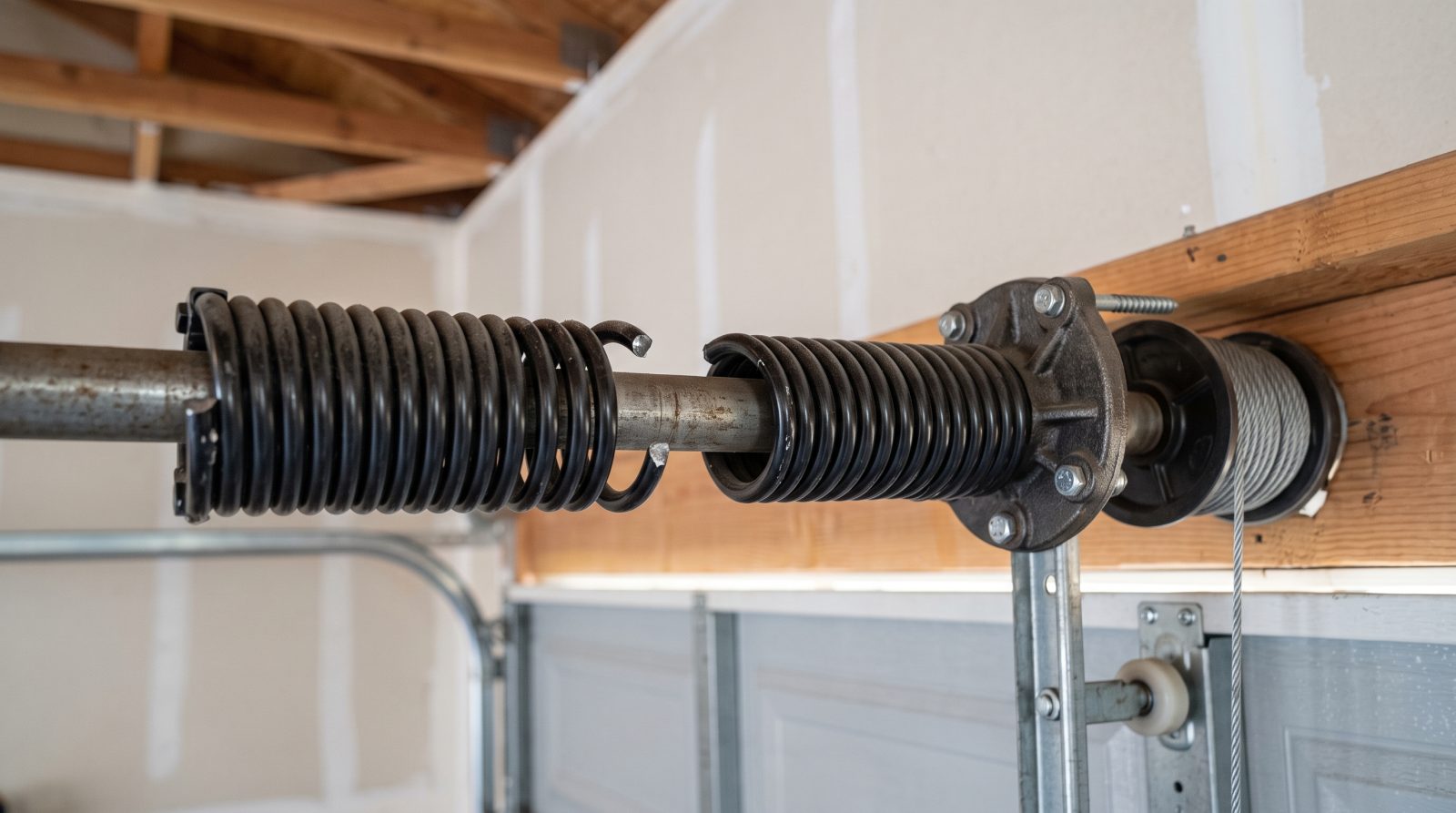
There are two main spring systems. Torsion springs mount horizontally on a metal shaft above the door opening and are the most common on modern doors. Extension springs run along the horizontal tracks on either side and stretch as the door closes. Torsion systems tend to last longer and fail more predictably, while extension springs are more exposed and can fail in ways that send parts flying, which is exactly why safety cables matter on that style.
Understanding this is the key to reading the symptoms: nearly every "broken spring" sign traces back to the loss of that counterbalance. Once you connect the dots, the warning signs stop feeling random and start telling a clear story.
- Torsion springs: mounted above the door on a shaft, common on newer doors, generally longer lifespan.
- Extension springs: mounted along the side tracks, older or lighter doors, should always have safety cables.
- Spring life is measured in cycles (one open + one close), commonly rated around 10,000 cycles, though heavy-duty springs run far higher.
- The opener moves the door, but the springs carry the weight; that's why a broken spring stops everything.
The Telltale Signs Your Spring Has Broken (or Is About To)
Spring failure usually shows up in a handful of distinct ways. Some are sudden and dramatic; others creep in over weeks. The single most common and unmistakable clue is a loud bang from the garage, often when no one is touching the door. People frequently describe it as sounding like a gunshot or a heavy object dropping. That sound is the spring snapping and releasing its stored tension all at once. If you heard that noise and the door has acted strangely since, a broken spring is the prime suspect.
After a break, the door's behavior changes immediately. The opener may hum, strain, or run for a moment and then stop, because it isn't built to lift the full weight alone. The door might rise just a few inches and quit, or it may refuse to move at all. If you try the manual release and lift by hand, a door with a broken spring will feel shockingly heavy and may slam back down rather than staying put. A healthy door, by contrast, should feel close to weightless and hold its position.
Visual and lesser signs round out the picture. Walk into the garage and look directly at the spring. On a torsion system, a broken spring shows a clear two- to three-inch gap where the coil separated. On extension springs, you may see a spring that's stretched out, disconnected, or dangling. Other warning signs include the door hanging crooked or jerking on one side, cables that have gone slack, or a door that has started moving noticeably slower or jerkier over time as a spring weakens before it fully snaps.
- A loud bang or gunshot-like noise from the garage, often with no one near the door.
- The opener runs or hums but the door won't lift, or lifts only a few inches then stops.
- A visible gap in a torsion spring coil, or a stretched, dangling, or disconnected extension spring.
- The door feels extremely heavy when lifted by hand after pulling the manual release.
- The door hangs crooked, sags on one side, or slams down quickly when you let go.
- Cables hanging loose or coming off the drums, often appearing right after a spring fails.
What Causes Springs to Break, and How Climate Plays a Role
Springs don't usually fail because of a defect; they fail because they've simply done their job thousands of times. Every open-and-close is one cycle, and springs are engineered for a finite number of them. A household that runs the door a few times a day may get many years out of a set, while a busy family treating the garage as the main entrance can burn through that cycle life far faster. This is why two identical doors on the same street can have wildly different spring lifespans.
Metal fatigue is the underlying culprit, and a few factors accelerate it. Rust is a major one: corrosion eats into the steel and creates weak points that crack under tension. Lack of lubrication lets the coils grind and wear. Poor installation, such as using a single spring where two were needed or undersized springs for the door's weight, dramatically shortens life. And one of the most overlooked accelerants is temperature.
Climate matters more than most homeowners expect, and this varies a lot by region. In colder northern states, springs are most likely to snap on the coldest mornings of the year, because steel becomes more brittle as the temperature drops and the metal contracts. It's genuinely common for a spring at the end of its life to make it through fall and then break during the first hard freeze. In humid coastal and southern regions, the bigger enemy is corrosion from salt air and moisture, which weakens springs from the outside in. Knowing your local climate helps explain why springs fail when they do and why a little seasonal maintenance pays off.
- Normal cycle wear: every open and close counts; heavy daily use shortens lifespan.
- Rust and corrosion: a top cause, especially in humid, coastal, or salt-air regions.
- Cold weather: brittle steel in freezing climates makes the coldest mornings peak failure time.
- Lack of lubrication: dry, grinding coils wear out faster.
- Improper sizing or installation: undersized or single-spring setups fail early.
What to Do the Moment You Suspect a Broken Spring
Once you've spotted the signs, the most important thing to know is what not to do. Stop using the door immediately. Do not keep pressing the opener button hoping it will catch; forcing the motor to fight a broken spring can burn out the opener, snap cables, or bend the tracks, turning a single repair into several. If the door is up, keep people, pets, and vehicles out from under it, because an unsupported door can come down hard and fast.
Resist the temptation to fix the spring yourself. Garage door springs are under extreme tension, enough to cause serious injury, and torsion spring replacement in particular requires specialized winding bars and training. This is widely considered one of the few garage door jobs that is genuinely dangerous for a DIY attempt. Replacing it correctly also means matching the exact spring size, wire gauge, and wind direction to your door's weight, which a pro measures and verifies.
If your car is trapped inside and you absolutely must get it out, the manual release cord (the red handle) disengages the door from the opener so it can move by hand, but remember a broken-spring door is very heavy and may need two people to lift safely and something to prop it open. The cleaner, safer path is to get a local technician to the door. Because springs are such a common failure, many repair pros stock the parts and can often handle this as a same-day visit, getting you back in business quickly. When you reach out, mention the bang you heard, whether the door moves at all, and which spring style you have if you can see it; that helps the pro arrive with the right parts.
- Stop pressing the opener; forcing it can damage the motor, cables, and tracks.
- Keep people, pets, and cars clear of an unsupported or partially open door.
- Don't attempt DIY spring replacement; the tension can cause serious injury.
- Use the manual release only with caution, ideally with help, to free a trapped car.
- Note the symptoms (noise, how far the door moves, spring type) when you call for help.
- It's strongly recommended to replace springs in pairs so the second doesn't fail soon after.
How a Local Repair Pro Diagnoses and Fixes It
A qualified technician starts by confirming it really is the spring and not a look-alike issue, since a door that won't open can also point to a snapped cable, a failed opener, or an off-track problem. They'll inspect the springs for breaks, check the cables and drums, test the door's balance, and weigh or estimate the door to size the replacement correctly. Getting the diagnosis right the first time is what separates a lasting fix from a repeat callout.
The repair itself involves safely releasing any remaining tension, removing the broken spring, installing a correctly rated replacement, and winding it to the precise tension your door needs. A good pro will then run the door through several cycles, check that it stays balanced and holds position when stopped halfway, lubricate the moving parts, and confirm the opener's force settings are appropriate now that the counterbalance is restored. Many will also do a quick safety check of the cables, rollers, and auto-reverse feature while they're there.
On cost, expect a typical industry range rather than a fixed number, since pricing varies by door size, spring type, the number of springs, local labor rates, and your region. As a general estimate, single-spring replacements often land in the lower part of the range and two-spring or heavy-duty jobs higher; high-cycle springs cost more upfront but last longer. Any honest quote should be confirmed after the technician sees your door. The bottom line is that a broken spring is a routine, fixable problem, and the fastest way back to a working door is a free quote from a local pro who can get to you quickly.
- Diagnosis rules out look-alikes: broken cables, opener failure, or an off-track door.
- Proper fix includes sizing, winding to correct tension, balance testing, and lubrication.
- A balanced door should hold its position when stopped roughly halfway open.
- Costs are estimates that vary by door, spring type, quantity, and region; confirm on site.
- Pairing replacement and a high-cycle upgrade can reduce the odds of another break soon.