Start With the Door, Not the Opener
The single biggest mistake homeowners make is shopping for an opener before understanding the door it has to lift. An opener doesn't actually carry the weight of your door; the springs do that. The opener's job is to overcome friction, guide the door along its track, and reverse instantly if something is in the way. But a door that's poorly balanced, fitted with worn springs, or running on dry rollers will make even a powerful opener work hard, strain its motor, and fail early. Before you spend a dollar on a new unit, it's worth knowing whether the opener is even the problem.
Door weight is the first variable. A basic single-layer steel door is light. A double-wide, insulated, multi-layer door, or a solid wood carriage-house door, can weigh two to three times as much. Heavier doors demand more lifting force and more durable hardware, and they're the most common reason a budget opener feels underpowered. Door size matters too: standard single doors, oversized single doors, and double doors each call for different capacity, and tall or custom doors may need a specific rail length.
Finally, check the balance and the springs. A well-balanced door, lifted halfway by hand with the opener disconnected, should mostly stay put rather than slam down or fly up. If it doesn't, you have a spring or balance issue, and bolting a new opener onto an unbalanced door just transfers the strain to the new motor. This is exactly the kind of fast diagnosis a local technician can do in minutes, and it's why help near you beats guessing from a big-box aisle.
- Door weight: light single-layer steel vs. heavy insulated or solid wood drives how much capacity you need
- Door size: standard single, oversized single, and double doors each need different opener capacity and rail length
- Balance test: disconnect the opener and lift the door halfway by hand; it should roughly hold position if springs are healthy
- Spring condition: a worn or broken spring will overload any opener, so fix the spring first, not the motor
- Headroom and side-room: tight ceilings or obstructions may steer you toward a wall-mount (jackshaft) opener
The Four Drive Types, and Who Each One Suits
The drive type is how the opener physically moves the door, and it's the decision that most affects noise, maintenance, and price. There are four common designs, and there's no single best, only the best fit for your home's layout and how much quiet you're willing to pay for.
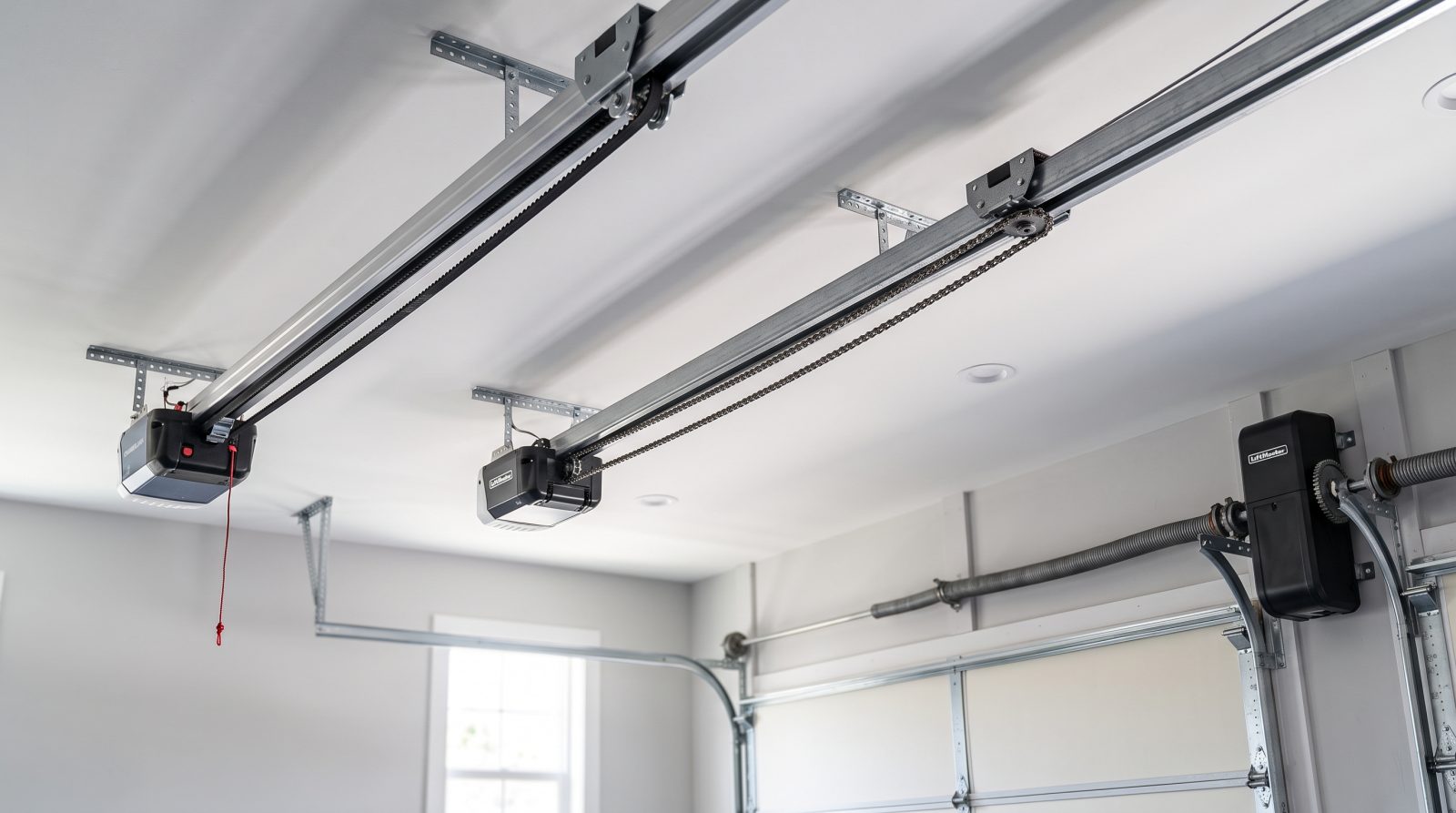
Chain-drive openers use a metal chain, much like a bicycle chain, to move the trolley along the rail. They're the workhorse of the category: durable, time-tested, strong enough for heavy doors, and the most affordable option. The trade-off is noise and vibration. If your garage is detached, or there's no living space directly above or beside it, a chain drive is often the smart, budget-friendly choice. If a bedroom sits over the garage, the rattle will get noticed.
Belt-drive openers swap the chain for a reinforced rubber or polyurethane belt. They run noticeably quieter and smoother, with less vibration, which makes them the go-to for attached garages and homes where someone sleeps above or beside the door. They cost more than chain drives and the belt can wear over many years, but for most attached-garage homes the quiet is worth it. Screw-drive openers move the trolley along a threaded steel rod. They have fewer moving parts and can be very strong, but they're sensitive to temperature swings: in regions with hot summers and cold winters the rod can expand and contract, so they generally need lubrication suited to the climate and have become less common than belt and chain. Wall-mount (jackshaft) openers mount on the wall beside the door rather than on the ceiling, driving the torsion bar directly. They free up overhead space, run quietly, and suit garages with high, low, or obstructed ceilings, vaulted spaces, or storage lifts, but they're the priciest option and require a door and spring setup compatible with side mounting.
- Chain drive: most affordable and very durable, but loudest; best for detached garages or no rooms above
- Belt drive: quiet and smooth, the popular pick for attached garages and bedrooms over the garage, costs more
- Screw drive: fewer parts and strong, but temperature-sensitive, so choose climate-appropriate lubrication; less common today
- Wall-mount / jackshaft: frees ceiling space and runs quiet, ideal for high or obstructed ceilings, highest price and needs compatible hardware
- Match the drive to your layout first, then optimize for noise and budget
Horsepower and Lifting Force: How Much Do You Really Need?
Opener power is usually advertised in horsepower (HP) or, increasingly, in horsepower-equivalent (HPe) for DC motors. More is not automatically better; what you want is enough lifting force to move your specific door comfortably, with a little headroom, without overpaying for capacity you'll never use. An underpowered opener strains and wears out early; a wildly oversized one is just wasted money.
As a general rule of thumb: lighter single doors are well served by lower-capacity openers, standard insulated single doors and most double doors do best in the mid range, and heavy insulated double doors, oversized doors, or solid wood doors call for the higher-capacity units. Because the springs carry the door's weight, the opener mainly needs to handle friction and momentum, but a heavier or larger door still benefits from a stronger motor and a sturdier rail so the unit isn't running at its limit on every cycle.
Pay attention to motor type as well as the number on the box. AC motors are simple and proven. DC motors are quieter, often allow soft start and soft stop (the door eases into motion and slows before it seats, which reduces wear and noise), and many come with a battery backup option. For a heavy door or a quiet-conscious household, a DC motor with soft start/stop in the mid-to-higher capacity range tends to be the sweet spot. When in doubt, it's better to slightly over-size than to buy right at the edge of what your door weighs; the motor will run cooler and last longer.
- Light single doors: lower-capacity openers are usually plenty
- Standard insulated single and most double doors: mid-range capacity is the comfortable choice
- Heavy insulated, oversized, or solid wood doors: step up to higher-capacity units with a heavier-duty rail
- DC motors: quieter, often include soft start/soft stop and battery-backup options, gentler on the door over time
- Aim for a little headroom above your door's needs; never buy right at the limit
Smart, Safety, and Convenience Features Worth Considering
Modern openers are no longer just a motor and a remote. The feature set has expanded a lot, and while some additions are genuinely useful every day, others are nice-to-haves. Here's how to separate the two. Start with safety, because some of it isn't optional. Photo-eye safety sensors, the small units mounted near the floor on each side of the door, are required on residential openers and reverse the door if anything breaks the beam. Auto-reverse force detection backs this up by reversing if the door contacts an object on the way down. If your current opener predates these protections, that alone is a strong reason to upgrade.
On the smart side, Wi-Fi connectivity with a phone app has become one of the most-used features. It lets you check whether the door is open, close it remotely if you forgot, and get alerts when it opens or closes, genuinely handy if you have kids, deliveries, or a tendency to second-guess yourself on the highway. Battery backup is the other feature many homeowners underrate: in regions prone to storms and outages, it keeps the door working when the power's out, which matters most for the heavy door you can't easily lift by hand. Look for whether smart features are built in or require an add-on module, and check what ecosystems the app works with.
Beyond those, weigh the convenience extras against your real habits. Built-in LED lighting brightens the garage far better than the old single bulb. Rolling-code or encrypted remotes improve security over older fixed-code units. Keypad entry on the outside is great for kids and service visits without a remote. Some openers integrate with smart-home platforms or in-car controls. None of these are essential, but if a feature solves an annoyance you actually have, it's usually worth the modest upcharge over a stripped-down model.
- Photo-eye sensors and auto-reverse: required safety features, a must-have, not an upgrade
- Wi-Fi app control: check status, close remotely, and get open/close alerts, one of the most-used modern features
- Battery backup: keeps a heavy door working during outages, especially valuable in storm-prone regions
- Built-in LED lighting and rolling-code/encrypted remotes: practical upgrades for visibility and security
- Exterior keypad and smart-home/in-car integration: convenient if they match how your household actually uses the garage
Typical Costs and Whether to Hire a Pro
Cost is where it helps to set honest expectations. The figures below are typical industry ranges, not quotes, and they vary widely by drive type, motor, brand, the features you choose, your door's size and weight, regional labor rates, and whether any worn hardware needs replacing during the job. Treat them as a planning guide, then get a specific quote for your door.
For the unit itself, basic chain-drive openers sit at the lower end of the range, belt-drive and DC-motor models with smart features land in the middle, and wall-mount (jackshaft) openers and premium feature-rich units sit at the top. Professional installation is commonly billed on top of the opener, and that labor typically covers mounting, wiring, programming remotes and the keypad, aligning the safety sensors, and testing the auto-reverse and balance. If your installer finds worn rollers, frayed cables, or tired springs while they're in there, addressing those at the same time is often cheaper than a separate trip later, but it does add to the total.
Could you install an opener yourself? A handy homeowner sometimes can, but it's worth being clear-eyed about the risks. The safety sensors and auto-reverse force must be set and tested correctly, the opener has to be programmed not to fight the door's travel limits, and any work near torsion springs is genuinely dangerous, those springs store enormous energy and cause serious injuries every year. A professional install also gets the unit sized and balanced to your specific door, which protects the motor you just paid for. For most people, having a local pro supply and fit the right opener, on the same visit, is the faster and safer path, and it's exactly the kind of common job a technician near you can handle quickly. When you're ready, request a free quote and have it sized and installed correctly the first time.
- All prices here are typical ranges, estimates that vary by door, drive type, features, region, and any added repairs, never a fixed quote
- Unit cost ladder: chain (lowest) to belt/DC-smart (mid) to wall-mount and premium (highest)
- Professional install usually adds labor for mounting, wiring, programming, sensor alignment, and safety testing
- Bundling worn rollers, cables, or springs into the same visit often costs less than a separate callout
- DIY is possible for the experienced, but spring work is hazardous and safety setup is critical, so when unsure, hire a pro