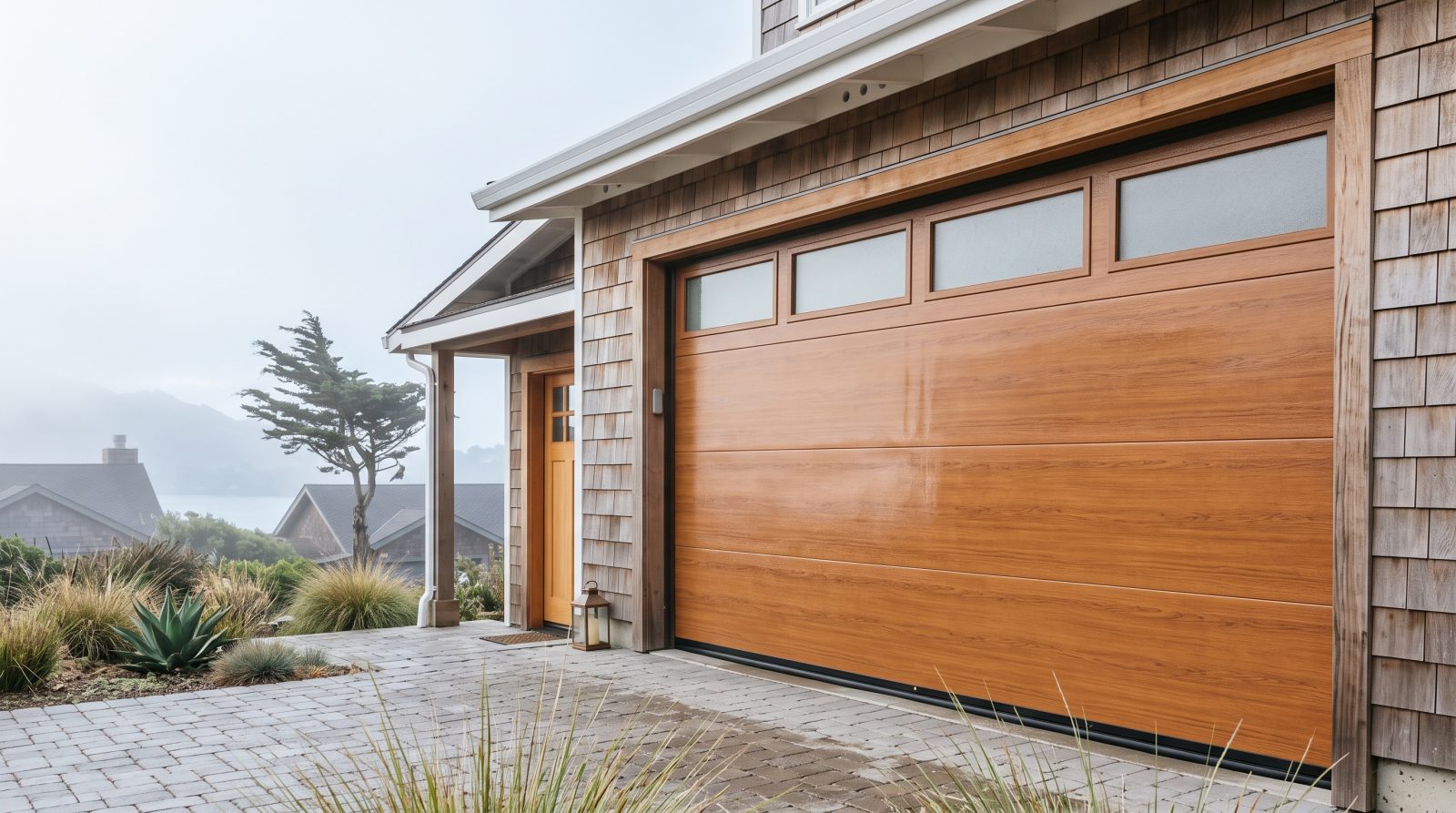
What a Fiberglass Garage Door Actually Is
The term "fiberglass garage door" is a little loose, and that causes a lot of confusion. In most modern doors, fiberglass isn't the whole panel: it's a durable composite skin (technically a fiberglass-reinforced polymer or a fiberglass overlay) bonded to a frame and an insulating core. The skin is what you see and touch; underneath, the door is usually built around a rigid foam core (often polyurethane or polystyrene) and an aluminum or composite frame that gives it shape and strength. That sandwich construction is the key to understanding both its strengths and its weak points.
Because the visible surface is a molded composite rather than painted metal or solid wood, fiberglass doors can be made to convincingly mimic natural wood grain at a fraction of wood's weight and maintenance. They're lighter than insulated steel, which can mean less strain on the opener and springs over time. But "lighter" and "composite" also mean the door behaves differently when something goes wrong: a cracked panel, a delaminated skin, or a faded finish are repair scenarios you simply don't get with steel.
It's worth knowing what you have before you call anyone. A quick way to tell: fiberglass doors tend to feel slightly warmer and more flexible to a knuckle-tap compared to the harder, colder ring of steel, and the grain texture is usually molded into the surface rather than printed flat. If you're not sure, that's fine: a technician can identify the door type on sight and tell you whether the material is the issue or just the hardware behind it.
- Surface: a molded fiberglass-composite skin, often textured to look like real wood grain
- Core: rigid foam insulation (polyurethane or polystyrene) for energy efficiency and rigidity
- Frame: aluminum or composite, lighter than steel, which can be easier on the opener and springs
- Behavior: more flex than steel, which is a strength in impacts but a factor in cracking
- Repairability: panel and skin issues differ fundamentally from steel dents or wood rot
Why Fiberglass Excels in Coastal and Humid Climates
This is where fiberglass earns its reputation. Steel garage doors, even galvanized and well-coated ones, are fundamentally vulnerable to rust, and nothing accelerates rust like salt air. If you live within a few miles of the ocean on either coast, along the Gulf, or anywhere sea spray and salt-laden humidity are part of daily life, a steel door is fighting a slow battle it can eventually lose at the seams, hardware, and any scratch that exposes bare metal. Fiberglass composite simply doesn't rust. That single property makes it one of the strongest candidates for coastal homes.
Humidity and moisture are the other half of the story. Wood doors in humid Southeast, Gulf Coast, and Pacific Northwest climates are prone to swelling, warping, and rot, and they demand regular sealing and refinishing to stay healthy. Fiberglass shrugs off moisture absorption: it won't swell, warp from damp, or rot, so it tends to keep its shape and operate smoothly through wet seasons that punish other materials. For homeowners who want a wood look without the wood maintenance in a damp climate, that combination is hard to beat.
Fiberglass also resists the corrosive grime and mildew buildup common in muggy regions, and the composite surface generally cleans up with mild soap and water. None of this makes fiberglass maintenance-free, since no door is, but in salt-and-moisture environments specifically, it removes the two failure modes (rust and rot) that drive the most expensive repairs on other door types. That's a big reason fiberglass is a frequent recommendation for beach towns and humid coastal corridors nationwide.
- Will not rust, a decisive advantage in salt-air and coastal-spray environments
- Resists swelling, warping, and rot that plague wood doors in humid regions
- Won't corrode at hardware seams the way steel can near the ocean
- Sheds mildew and coastal grime; cleans with mild soap and water
- A practical wood-look alternative for damp climates where real wood struggles
The Honest Downsides: Where Fiberglass Struggles
No material is perfect, and being clear about fiberglass's weaknesses is what separates a useful guide from a sales pitch. The biggest one is cold-weather brittleness. In genuinely cold climates (think Upper Midwest, Northeast, and Mountain West winters), fiberglass composite can become more brittle as temperatures drop, which makes it more prone to cracking from a hard impact such as a stray basketball, a backing bumper, or a slammed door in a freeze. Where steel might dent and recover, fiberglass can crack, and a cracked panel is a more involved fix. For that reason, fiberglass is often a better fit for moderate, warm, and coastal climates than for deep-freeze regions.
Insulation is the second consideration. While fiberglass doors do include a foam core, their overall insulating performance (R-value) can trail the best insulated-steel doors, depending on the specific model and core thickness. If your garage is conditioned, attached to living space, or in a climate with brutal summers or winters, it's worth comparing the actual R-value of any fiberglass door against an insulated steel equivalent rather than assuming they're equal.
Finally, intense, prolonged UV exposure can fade the finish over years, particularly on south- and west-facing doors in high-sun states. Quality finishes and UV-stable coatings have improved a lot, but a door that bakes in Arizona, Texas, or Florida sun all day will tend to show its age faster than one in a shaded or temperate spot. And while fiberglass resists rust and rot, the hardware behind it (springs, rollers, cables, hinges) is the same hardware found on any door and wears out on the same timeline.
- Brittleness in cold climates: more likely to crack than dent on hard impact
- Insulation (R-value) can lag the best insulated-steel doors; compare specs directly
- Finish can fade over years under intense UV on sun-facing, high-heat exposures
- Cracked or delaminated panels are a more specialized repair than a steel dent
- The mechanical hardware wears the same as any door, regardless of skin material
Common Fiberglass Door Problems and How a Pro Diagnoses Them
When a fiberglass door acts up, the first job is separating a material problem from a hardware problem, and most of the time, it's hardware. A door that's noisy, jerky, sagging, or won't open is almost always a spring, cable, roller, or opener issue, not the fiberglass itself. That's good news, because those are routine fixes that apply to any door type. The classic culprits are a broken torsion or extension spring (the door suddenly feels impossibly heavy or won't lift), frayed or off-track cables, worn rollers (grinding and shuddering), or an opener that's lost its travel and force settings.
The problems that are specific to fiberglass are surface and panel issues. Cracking, usually from an impact or from cold-weather brittleness, shows up as a visible split or stress line in a panel. Delamination is when the composite skin starts separating from the core, often appearing as a bubble, soft spot, or peeling edge, and it's frequently moisture- or age-related. Fading and chalking of the finish are cosmetic but tell you the surface coating is breaking down. A technician inspects for these by sight and touch, checks whether a single panel can be replaced versus the whole door, and confirms the frame and core underneath are still sound.
A thorough diagnostic visit is methodical: a balance test (disconnect the opener and lift the door halfway by hand to check spring tension), inspection of springs, cables, rollers, hinges, and track alignment, a look at the opener's safety sensors and force settings, and then a separate assessment of the panel and finish condition. That sequence is the same nationwide; what changes by region is which failures are most common. Coastal techs see less rust but watch for delamination and finish wear, while cold-climate techs see more impact cracking and brittle-weather spring failures.
- Hardware first: broken springs, off-track or frayed cables, worn rollers, opener faults, usually the real cause
- Cracking: visible splits from impact or cold-weather brittleness in a panel
- Delamination: skin separating from the core (bubbling, soft spots, peeling edges)
- Finish failure: fading or chalking that signals the surface coating is wearing
- The balance test (lift the door by hand with the opener disconnected) is the fastest first check
Repair vs. Replace, and What It Typically Costs
Most fiberglass garage door calls end in a repair, not a replacement, because most calls are about hardware, and hardware is replaceable on any door. If the fiberglass panels are sound and the problem is a spring, cable, roller, or opener, a repair is almost always the right and far cheaper call. Where replacement enters the conversation is when one or more panels are cracked or delaminated and the door is older, when the same door has needed repeated fixes, or when the frame or core behind the skin has failed. A single damaged panel can sometimes be replaced individually if the model and matching panels are still available, but on discontinued or older doors, finding a match can be the deciding factor.
On cost, treat every figure here as a typical industry range and an estimate, not a quote: the real number depends on your door size, the specific parts, your region's labor rates, and the scope of work. As general guidance, spring replacement commonly runs in the low-to-mid hundreds; roller, cable, and hinge replacements are typically more modest; opener replacement is usually a few hundred dollars depending on the unit and features; and a full fiberglass door replacement is the big-ticket item, generally ranging into the low-to-mid thousands depending on size, insulation, design, and finish. Coastal and high-cost-of-living metros tend toward the upper end of any range, while many other areas land lower.
The practical way to decide is to get eyes on the door. A technician can usually tell you in one visit whether you're looking at a quick hardware fix or a panel-and-finish situation that tips toward replacement, and can lay out the options honestly with real numbers for your door and your area. If your fiberglass door is acting up, whether it's a sudden won't-open emergency or a slow decline in how it looks and runs, the fastest path is to have a local pro diagnose it on-site. You can request a free quote and get same-day help in many areas.
- Repair usually wins when panels are sound and the issue is hardware (springs, cables, rollers, opener)
- Replace when panels are cracked or delaminated on an older door, or the frame/core has failed
- Single-panel replacement is possible if matching panels for the model are still available
- Cost ranges are estimates that vary by door size, parts, scope, and regional labor rates
- One on-site diagnosis is the fastest, most honest way to settle repair vs. replace