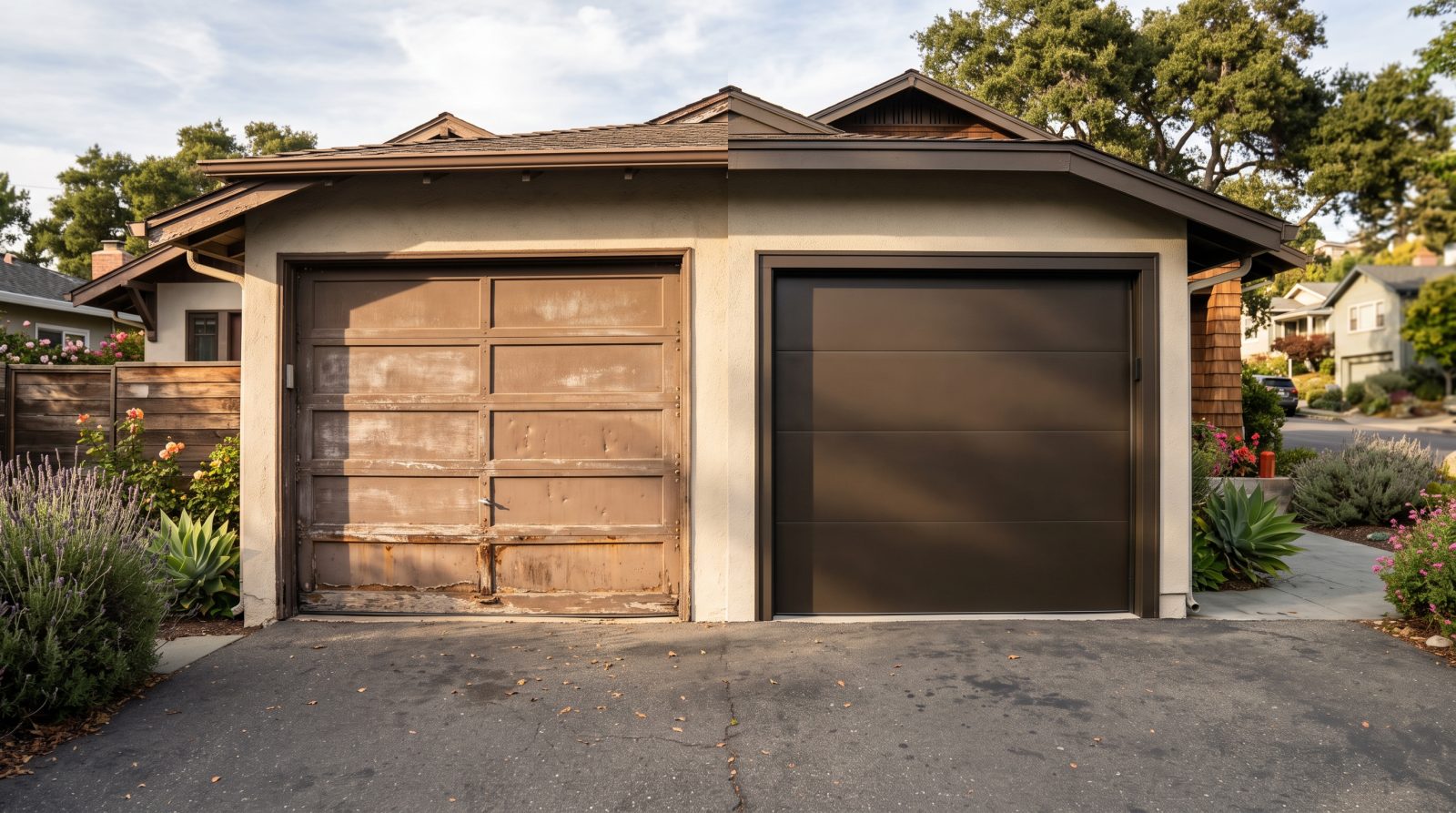
The Three Lifespans Hiding Inside Your Garage Door
When homeowners ask how long a garage door lasts, they are usually picturing the panels, the big visible part that swings up and down. But the panels are typically the longest-lived component on the whole system. The parts that fail first and most often are the ones you never see: the springs that counterbalance the door's weight, and the opener that turns a button-press into motion. Treating these as one unit is the single most common reason people are caught off guard by a failure.
Roughly speaking, the panels themselves are designed to last a couple of decades or more, the opener motor unit is a long-term appliance with a finite electronic and mechanical life, and the springs are a true wear item rated in cycles rather than years. Each ages on its own clock, and each is affected differently by use and climate. A door that gets opened eight times a day in a humid coastal town ages very differently from one opened twice a day in a dry, mild region.
- Door panels (steel, aluminum, wood, composite): typically the longest-lasting component, often 20-30+ years depending on material and maintenance.
- Opener (the motor unit): commonly lasts on the order of 10-15 years, sometimes longer, before motor, logic board, or drive wear forces replacement.
- Springs (torsion or extension): rated in cycles, not years, with many standard springs designed for roughly 10,000 cycles, often translating to about 7-12 years of average household use.
- Cables, rollers, hinges, and tracks: supporting hardware that usually outlasts springs but should be inspected on the same schedule.
How Long Garage Door Springs Really Last
Springs are the hardest-working and shortest-lived part of the system, and they are also the part most likely to leave you stranded. A spring does not wear out by the year; it wears out by the cycle, where one cycle is a single open-and-close. A spring sold as a 10,000-cycle spring is engineered to survive roughly that many open-and-close movements before it is at meaningful risk of breaking. How fast you burn through those cycles is entirely up to your household.
Do the math on your own usage and the picture becomes clear. A family that opens the door four times a day uses about 1,460 cycles a year, which puts a 10,000-cycle spring at around six to seven years. A household that uses the garage as the main entrance, cycling it eight or more times daily, can reach that limit in three to four years. This is why two identical doors installed the same week can have springs fail years apart. Higher-cycle springs (15,000 or 25,000 cycles) exist and are often worth the modest upcharge for heavy-use homes.
When a spring breaks, the door becomes extremely heavy and unsafe to operate, and the opener may strain or refuse to lift it. Spring replacement is one of the most common garage door repairs in the country, and because the springs are under enormous tension, it is genuinely dangerous to attempt as a DIY job. This is a fast, routine fix for a trained pro and a serious injury risk for a homeowner with the wrong tools.
- Typical lifespan: roughly 7-12 years for a standard 10,000-cycle spring under average use; far less for high-traffic homes.
- Failure is sudden: springs usually snap without warning, often with a loud bang, leaving the door too heavy to lift safely.
- On a two-spring system, replace both at once: the second is usually close behind, and matched springs keep the door balanced.
- High-cycle upgrades pay off for daily-use households and can roughly double expected spring life.
How Long Garage Door Openers Last
The opener is best thought of as an appliance: a motor, a drive mechanism, and a small computer, all working together. Like any appliance, it has a finite life, and most units give reliable service for somewhere in the range of 10 to 15 years before age starts to show. Some run well beyond that, particularly higher-quality units that are maintained and lightly used, but past the 15-year mark you are generally living on borrowed time.
Openers rarely die all at once. They warn you. The motor begins to sound louder or labored, the door hesitates or reverses for no clear reason, the remote range shrinks, or the logic board starts behaving erratically. Drive type matters too: chain drives are durable but noisier, belt drives run quieter, and screw drives sit in between, with the smoothness of operation often affecting how an aging unit feels long before it actually fails.
There is also a safety dimension to opener age. Federal safety standards have required photo-eye reversing sensors on residential openers since the early 1990s, so a very old opener may lack modern safety features and rolling-code security entirely. If an opener is more than 15 to 20 years old, replacement is often the smarter call than repeated repairs, both for reliability and for the safety upgrades that come with a new unit. Frequently, though, a misbehaving opener is not the motor at all but a misaligned sensor or a worn gear, which a technician can often diagnose and fix on the spot for a fraction of replacement cost.
- Typical lifespan: about 10-15 years, with well-maintained units sometimes running longer.
- Early warning signs: louder or grinding motor, intermittent operation, shrinking remote range, unexplained reversing.
- Repair vs. replace: a single failed gear or sensor is usually a cheap fix; an aging motor on a 15+ year unit usually points to replacement.
- Older openers may lack photo-eye safety sensors and rolling-code security, which are reasons to upgrade beyond reliability alone.
How Long the Door Itself Lasts and What Material Changes
The door panels are the long-haul component, and with reasonable care a quality door can serve 20 to 30 years or more. The material is the biggest variable. Steel doors, the most popular choice nationwide, are durable and low-maintenance but can dent and, in coastal or road-salt environments, eventually rust at seams and edges. Aluminum resists rust and is light, which is gentle on the opener and springs, but dents more easily. Wood doors are beautiful and can last a very long time, but they demand periodic refinishing and are sensitive to moisture. Composite and faux-wood doors aim to split the difference, offering the wood look with less upkeep.
Climate is the quiet force shortening door life across the country, and it works differently from region to region. In humid and coastal areas, salt air and moisture accelerate rust on steel hardware and corrode springs and cables faster than published cycle ratings suggest. In hot, sun-baked regions, UV exposure fades and can warp finishes and stress weatherstripping. In cold-winter climates, repeated freeze-thaw cycles, road salt, and lubricant thickening in the cold all put extra strain on springs and openers, which is part of why spring failures spike on the first hard cold snap of the season. None of this means a door in a tough climate is doomed; it means maintenance matters more and inspections should be more frequent.
The good news is that the door's longevity is highly influenced by simple upkeep. Keeping the door balanced, the rollers and hinges lubricated, the tracks clear, and the weatherstripping intact removes strain from every other component. A balanced, well-lubricated door asks less of its springs and opener, which is the single most effective way to push every lifespan number in this guide toward the higher end.
- Door panels: often 20-30+ years; the longest-lived part of the system when maintained.
- Steel is durable but dent- and rust-prone near coasts; aluminum resists rust but dents; wood lasts long with upkeep; composite balances look and maintenance.
- Coastal salt air, intense sun, and freeze-thaw winters each shorten hardware life in different ways, region by region.
- Twice-yearly lubrication, balance checks, and track cleaning are the cheapest way to extend every component's life.
Warning Signs and When to Call a Local Pro
Most garage door failures announce themselves before they become emergencies, if you know the signals. Catching them early turns a stressful breakdown into a scheduled, lower-cost repair. The most important habit is a simple monthly look-and-listen: watch the door go up and down, and pay attention to new noises, jerky movement, or sagging on one side. A door that is suddenly heavy to lift by hand, or that slams down rather than gliding, is telling you the springs are losing their balance.
Certain symptoms mean stop using the door and call a professional rather than forcing it. A snapped spring (often visible as a gap in the coil), a frayed or loose cable, a door that is off its track, or a door that won't stay open are all situations where continued operation risks injury and further damage. Off-track doors and broken cables in particular can fail catastrophically and should be treated as do-not-touch until a technician arrives.
The convenience of garage door repair is that these common problems, springs, openers, off-track doors, and cables, are exactly the issues local pros handle every day, and most are same-day, in-and-out jobs once a technician is at your door. Repair costs vary widely by part, door size, material, and your region, so any figure is a typical industry range and an estimate, not a quote; a single spring or a sensor realignment sits at the lower end, while a full opener swap or multi-panel replacement runs higher. Wherever you are, the right move when you spot a warning sign is to get a qualified local technician out to diagnose it before a worn part becomes a stuck car and a ruined morning. If you are noticing any of these signs, request a free quote and get a local pro on the way.
- Call promptly for: grinding or louder operation, jerky or uneven movement, a door that feels heavy by hand, or shrinking remote range.
- Stop using the door and call now for: a broken spring, a frayed or loose cable, an off-track door, or a door that won't stay open.
- Do a 60-second look-and-listen test monthly, and a fuller balance and lubrication check twice a year.
- Repair costs are typical industry ranges that vary by part, door, and region, not fixed quotes; most common repairs are same-day fixes.