Start With How You Actually Use the Garage
Before comparing brochures, get clear on what the garage really is in your life. An attached garage that doubles as a laundry room, gym, workshop, or the main entrance you use every single day has very different demands than a detached structure you open twice a week to grab tools. The more a door is part of your daily living space, the more insulation, quiet operation, and reliability are worth paying for.
Cycle count is the quiet driver of long-term cost. Every full open-and-close is one 'cycle,' and the springs that do the heavy lifting are rated for a set number of them — commonly around the 10,000-cycle range as a standard baseline, with higher-cycle springs available. A two-car household that opens the door six to eight times a day will burn through a standard spring far faster than a household that opens it twice. If you're a heavy user, asking your installer about higher-cycle springs up front is one of the cheapest ways to avoid a future breakdown.
Also think about climate honestly. In hot, humid, or coastal regions, corrosion and sun exposure matter more; in cold northern climates, insulation and how a door's seals handle freezing matter more; in storm-prone coastal zones, wind load can even be a code requirement. Your usage plus your climate should shape every choice below, so a door that's perfect in Arizona isn't automatically right in Minnesota.
- Daily-use / attached garage: prioritize insulation, quiet operation, and higher-cycle springs.
- Occasional / detached garage: you can lean toward simpler, lower-cost builds.
- Hot or coastal climates: weigh corrosion resistance and sun-fade on finishes.
- Cold climates: prioritize insulation R-value and quality weather seals.
- Storm-prone coastal areas: check whether local code requires a wind-rated door.
Choosing a Material: Steel, Aluminum, Wood, Composite & Fiberglass
Material is the single decision that affects price, maintenance, durability, and the look of your home all at once. There's no universally 'best' material, only the best fit for your climate, budget, and how much upkeep you're willing to do. Here's how the common options actually behave over years of use.
Steel is the most popular choice across much of the country for good reason: it's strong, low-maintenance, widely available in insulated multi-layer constructions, and offered at nearly every price point. Its main weakness is that dents can be hard to undo, and in salty coastal air, lower-grade steel can be prone to rust over time if the finish is scratched. Aluminum is lighter and naturally rust-resistant, which makes it a sensible pick near the coast, and it's common in modern full-view glass-and-frame doors, but it dents more easily than steel.
Wood delivers a warmth and custom look nothing else quite matches, and it can be repaired and refinished, but it's the highest-maintenance option — expect periodic sealing or repainting — and it dislikes wide humidity swings. Composite (wood-look) and fiberglass doors aim to give you the wood appearance with far less upkeep; fiberglass in particular resists dents and corrosion, which suits coastal and humid regions, though it can become brittle and crack under hard impacts in very cold weather. Match the material to your environment first, then to your aesthetic.
- Steel: durable, low-maintenance, strong value range; dents are tough to fix, and can rust if coastal and scratched.
- Aluminum: lightweight, rust-resistant (good near coast), great for full-view glass looks; dents easily.
- Wood: premium custom look, repairable/refinishable; highest maintenance, sensitive to humidity.
- Composite (wood-look): wood appearance, much lower upkeep; mid-to-upper price.
- Fiberglass: resists dents, rust, and salt air; can get brittle in extreme cold.
Style and Curb Appeal Without Sacrificing Function
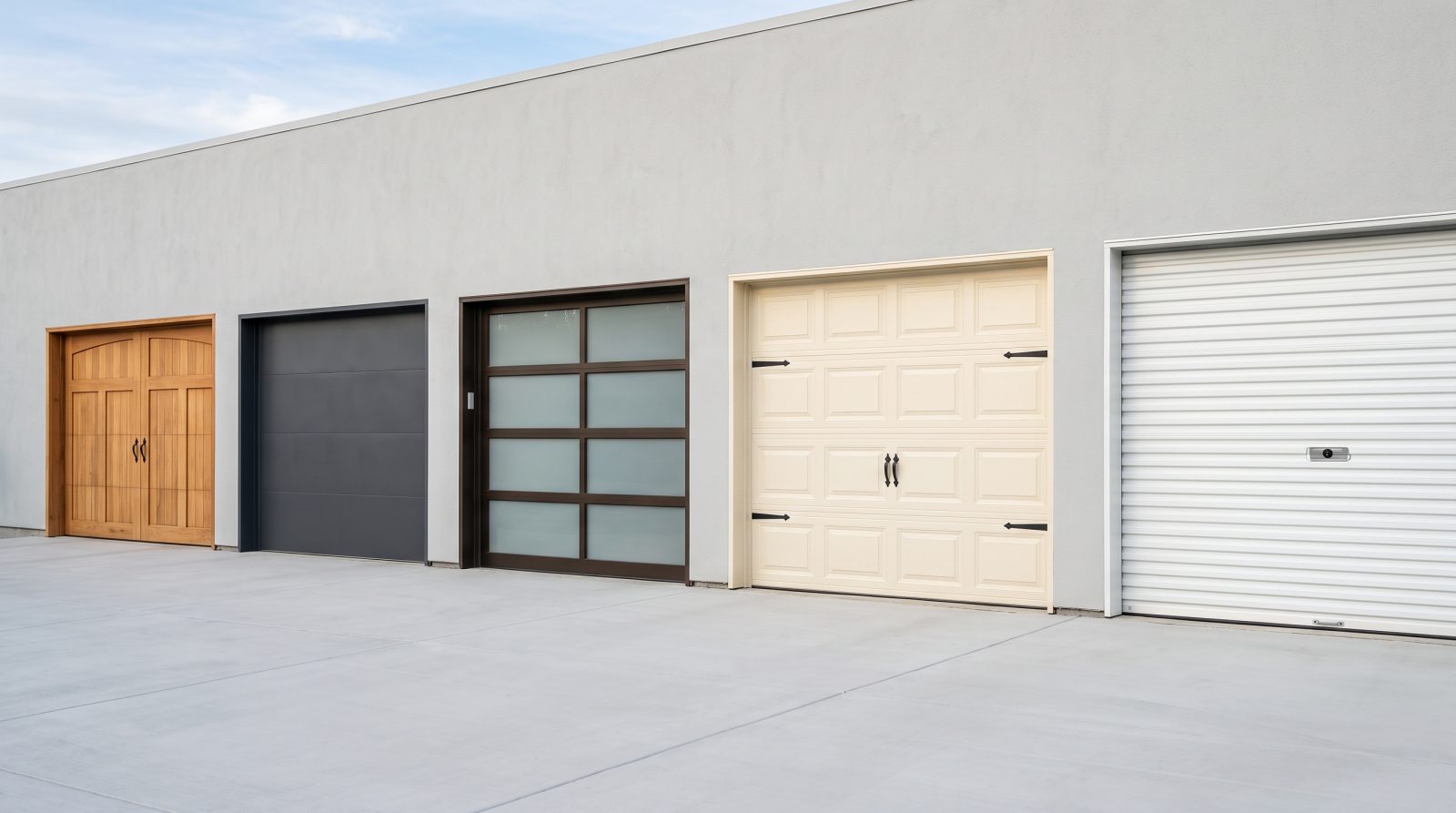
Style breaks down into the door's overall design language and its window and hardware details. The most common designs are traditional raised-panel (the classic look on most homes), carriage-house (which mimics old swing-out barn doors but still rolls up overhead), and modern/contemporary (clean flush panels, often with aluminum frames and frosted or clear glass). A good rule of thumb is to echo your home's architecture and trim color rather than chasing a trend, since the door is too large and too expensive to swap on a whim.
Windows change both the look and the function. They bring natural light into the garage — a real plus if you work in there — but they also add weight, can reduce insulation value where the glass sits, and create a sightline into your garage unless you choose frosted or obscured glass for privacy. Decorative hardware and the door's color can lift curb appeal for relatively little money, which is why a fresh, well-chosen door is frequently cited among the higher-return exterior improvements you can make before selling.
One practical caution: more glass and more custom detailing usually mean more weight and more moving complexity, which can mean more to maintain over the door's life. A heavier door puts more demand on springs, rollers, and the opener. None of that should scare you off a look you love — just factor it into the springs and opener you choose so the system is sized for the door, not fighting it.
- Traditional raised-panel: most common, easy to match to almost any home.
- Carriage-house: charming barn-door look that still operates overhead.
- Modern/contemporary: flush panels, aluminum-and-glass, clean lines.
- Windows add light and curb appeal but add weight; choose frosted glass for privacy.
- Match the door to your home's style and trim color rather than to a passing trend.
Insulation and R-Value: What the Numbers Mean
Insulation is measured in R-value, a rating of how well the door resists heat transfer — higher numbers mean better insulation. Doors generally come in three constructions: single-layer (a single panel of steel or other material, no insulation, lowest R-value), double-layer (a layer of polystyrene insulation behind the panel), and triple-layer (insulation sandwiched between two panels — the quietest, sturdiest, and highest R-value). It's worth knowing that R-value claims aren't measured identically by every brand, so treat a single headline number as a guide rather than gospel, and compare construction type alongside it.
Whether insulation pays off depends heavily on your situation. If the garage is attached, shares a wall or ceiling with living space, or is conditioned for use as a shop or gym, insulation can meaningfully steady the temperature and cut energy loss, and the difference is most pronounced in regions with cold winters or brutally hot summers. For a detached garage you rarely heat or cool, a high R-value is far less impactful and may not justify the added cost.
Insulation also delivers two benefits that don't show up on the R-value label: it makes doors noticeably quieter (a real perk when bedrooms sit above or beside the garage), and the multi-layer construction that carries insulation is simply more rigid and more dent-resistant than a thin single skin. So even in a mild climate, stepping up to an insulated, multi-layer door often buys you durability and quiet, not just energy savings.
- Single-layer: no insulation, lowest cost, best only for detached/unconditioned garages.
- Double-layer: insulation behind the panel; a sensible middle ground.
- Triple-layer: insulation between two panels; quietest, sturdiest, highest R-value.
- Higher R-value matters most for attached or conditioned garages and extreme climates.
- Insulated, multi-layer doors are also quieter and more dent-resistant, regardless of climate.
Setting a Realistic Budget (and the Costs People Forget)
Garage door pricing varies widely by size, material, insulation, window and hardware options, and your region's labor rates, so think in ranges, not fixed figures. As a rough industry guide, a basic single-car door installed often falls in the low-four-figures range, mid-tier insulated steel doors tend to run higher, and large two-car, custom wood, or full-view glass doors can reach well into the thousands. These are typical estimates that vary by door, material, and scope — not a quote; the only accurate number is one a local installer gives you after measuring your actual opening.
The line items people forget are usually the ones that bite later. The opener may need replacing alongside the door, especially if you're moving to a heavier insulated or glass door that an older opener wasn't sized to lift. Old hardware (springs, rollers, cables, track) is frequently replaced with the door, and skimping here is a false economy because those are the exact parts that cause breakdowns. Haul-away of the old door, and in some cases a permit, can add to the total too. A quality, properly sized installation costs more upfront but is what keeps you out of the repair cycle.
The smartest way to budget is to weigh upfront price against expected reliability and maintenance. A bargain single-layer door with a builder-grade opener and standard-cycle springs can absolutely be the right call for a low-use detached garage, but for a door you operate many times a day, paying a bit more for an insulated build, higher-cycle springs, and a properly matched opener typically means fewer service calls over the door's life. When you're comparing bids, ask each installer to itemize the door, the opener, the spring system, and the labor so you're comparing the whole system, not just the panel.
- Treat all prices as ranges; the only real number comes from measuring your opening.
- Budget for the opener, especially if upgrading to a heavier insulated or glass door.
- Replacing springs, rollers, cables, and track with the door prevents near-term failures.
- Account for haul-away of the old door and a permit where it's required.
- Get itemized bids (door, opener, springs, labor) so you compare the full system.
Buying Smart: Sizing, Safety, and Installation
Correct sizing and professional installation matter as much as the door you pick. Standard single-car openings are commonly around 8 to 9 feet wide and two-car openings around 16 feet, but heights and headroom vary, and an opening that's even slightly off can mean a custom order. Don't guess from a tape measure and a brochure; an installer measures width, height, headroom, and side room to confirm the door and track system will fit and operate smoothly.
Safety features are non-negotiable on any modern system. Photo-eye sensors that reverse the door when something crosses the threshold and an auto-reverse function are standard safety expectations, and they're worth testing periodically once installed. The torsion springs that counterbalance the door store enormous tension; adjusting or replacing them is genuinely dangerous and is firmly in professional territory, not a DIY job. This is the area where trying to save on labor can cause serious injury.
Finally, plan for the relationship after install, not just the purchase. Ask about warranty terms on the door, the springs, and the opener separately, and keep the model details somewhere you can find them, because when a roller wears out or a spring eventually breaks (and over enough cycles, every spring eventually does), knowing exactly what you have makes getting a local pro out to fix it fast and painless. That fast-fix moment is exactly what this site exists for. When you're ready to choose and install, request a free quote and a local installer can measure your opening and walk you through the options that fit your home and climate.
- Have an installer measure width, height, headroom, and side room before ordering.
- Insist on photo-eye sensors and auto-reverse, and test them periodically.
- Never DIY torsion-spring work; the stored tension makes it genuinely dangerous.
- Get separate warranty terms for the door, springs, and opener, and save your model info.
- Keep your door details handy so future repairs (springs, rollers) are fast to schedule.