When It's Time for a New Opener (vs. a Repair)
Not every opener problem means you need a replacement. A door that suddenly stopped working often has a simple cause, a dead remote battery, a misaligned photo-eye sensor near the floor, a tripped outlet, or the unit accidentally set to lock or vacation mode. It is always worth ruling those out before assuming the motor is finished. But there is a point where replacement is the smarter long-term move, and recognizing it saves you from pouring money into an aging unit.
Replacement generally makes sense when the opener is old enough that parts are hard to source, when the motor itself has burned out, or when repeated repairs are stacking up close to the price of a new unit. Age is also a safety factor: openers manufactured before 1993 may lack the photo-eye auto-reverse system that is now federally required, which means an older unit can be both unreliable and less safe. New construction, a garage conversion, or replacing a door that never had an opener are the other obvious reasons to install fresh.
One important note before any swap: the opener does not lift the door, the springs do. The opener only guides and powers that motion. If your door feels heavy, jerks, or struggles, the springs or cables may be the real culprit, and bolting a new opener onto an unbalanced door will only wear it out faster. A good technician checks door balance first and tells you honestly whether you need an opener, a spring service, or both.
Chain vs. Belt vs. Screw Drive: Choosing the Right Mechanism
The drive type is the single biggest decision in an opener purchase, because it shapes how loud the door is, how much maintenance it needs, and how it performs in your climate. There is no universally best option, only the best fit for your home, your budget, and where your garage sits relative to living space.
Chain-drive openers are the long-standing workhorse. A metal chain pulls a trolley that moves the door, much like a bicycle chain. They are typically the most affordable, extremely durable, and strong enough for heavy doors, which is why they remain so common. The trade-off is noise and vibration, the metal-on-metal action is the loudest of the three. For a detached garage or a home where no one sleeps above or beside the garage, that noise rarely matters and the value is hard to beat.
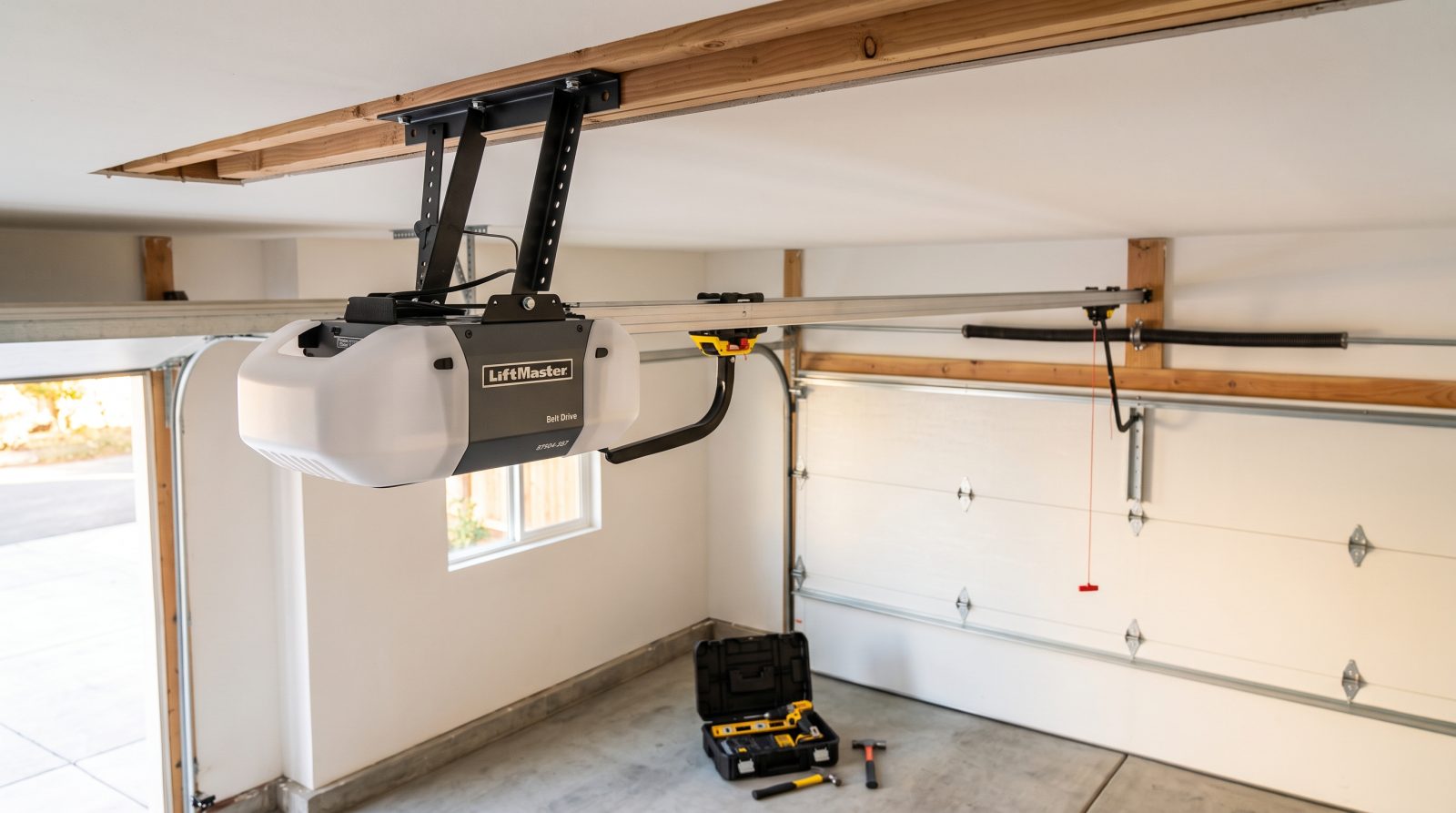
Belt-drive openers swap the chain for a reinforced rubber or polyurethane belt. They run noticeably quieter and smoother, which is why they are the go-to when there is a bedroom over or next to the garage, a common situation in newer two-story homes. They tend to cost more than chain drives and the belt is a wear item over many years, but for quiet operation they are the most popular premium choice.
Screw-drive openers use a threaded steel rod that the trolley travels along, with fewer moving parts than a chain system. They can move the door quickly and historically required little maintenance, sitting between chain and belt on noise. Their performance can be more sensitive to temperature swings, so in regions with wide seasonal extremes the threaded mechanism benefits from periodic lubrication. They have become less common than chain and belt, but they still suit certain doors and budgets well.
A fourth category worth knowing is the wall-mount or jackshaft opener, which mounts beside the door on the wall rather than on the ceiling. These free up overhead space, run very quietly, and work well with high-lift or cathedral-ceiling garages, though they usually carry the highest price and require compatible hardware.
Smart Wi-Fi Openers and the Features That Actually Matter
Smart openers have moved from novelty to mainstream, and for many homeowners the convenience is genuinely useful rather than gimmicky. A Wi-Fi-connected opener lets you open, close, and check the door's status from a phone app anywhere, which answers the nagging did-I-leave-the-garage-open question and lets you let in a family member or delivery from across town. Many also send alerts when the door opens or closes and log activity history.
Beyond basic app control, the features worth weighing include battery backup, which keeps the door working during a power outage and is actually required by law in some states for new installations, so it is worth confirming what your area mandates. Built-in LED lighting, integration with voice assistants and smart-home platforms, and compatibility with in-app guest access or delivery services are common add-ons. Some openers offer rolling-code or encrypted security that changes the access code with each use to resist code theft, a meaningful security upgrade over very old fixed-code remotes.
Smart capability can come built into the opener or be added through an adapter on certain existing units, so you are not always forced into a full replacement to gain app control. When choosing, focus on the features you will genuinely use. App control and security upgrades are nearly universal wins; some of the more elaborate integrations matter only if they fit how you actually live. A local installer can confirm which models are compatible with your door, your Wi-Fi setup, and any local code requirements before you commit.
Sizing the Opener: Horsepower, Door Weight, and Compatibility
An opener that is underpowered for the door will strain, run hot, and wear out early, while a sensible match runs smoothly for years. Power is usually described in horsepower (HP) or horsepower-comparable ratings, and the right level depends mainly on the door's size, material, and weight.
As a general guide, lighter single-car doors are often served well by lower-power units, while heavier two-car doors, insulated doors, and solid-wood or carriage-style doors benefit from more power and torque. A standard double-width steel door is commonly paired with a mid-range opener, and large, heavy, or oversized doors call for the higher end. Insulation and door material add weight that is easy to underestimate, which is exactly why a quick on-site assessment beats guessing.
Compatibility goes beyond raw power. The opener has to suit your ceiling height and rail length, your door's track style (standard lift, high lift, or vertical), and the headroom available above the door. Sectional doors, the most common residential type, work with typical trolley openers, while some specialty doors need specific hardware. Getting these details right is a big part of why professional installation pays off, the unit, the rail, and the safety sensors all have to be set up and aligned to the specific door.
What Installation Involves and Typical Cost Ranges
A proper opener installation is more than mounting a motor to the ceiling. It includes assembling and hanging the rail, securely anchoring the motor unit, mounting the wall control, installing and aligning the photo-eye safety sensors near the floor, connecting power, programming remotes and any keypad, and, critically, testing the door's balance and the auto-reverse safety function so the door stops and reverses if something is underneath it. A safe auto-reverse test is one of the most important steps and one that DIY installs frequently get wrong.
Cost varies widely, and any figure here should be treated as a typical industry range and an estimate, not a quote. The price depends on the drive type you choose, the opener's power and smart features, your door's size and weight, whether existing hardware can be reused, and regional labor rates. As a rough framing, a basic chain-drive unit sits at the lower end, belt-drive and smart Wi-Fi models cost more, and wall-mount openers and heavy-duty units are typically the priciest, with professional labor added on top. Battery backup, a keypad, extra remotes, or new mounting hardware can each nudge the total.
Because so many variables are in play, the only accurate number comes from an on-site look at your actual door and garage. Drive type and climate also shape the long-run cost: a quieter belt drive may cost more upfront but suits a home with bedrooms over the garage, while a durable chain drive can be the better value for a detached or workshop garage. A local pro can walk you through the options for your specific situation. When you are ready, request a free quote and get the right opener installed and safety-tested the first time.