What "off-track" actually means and how to spot it
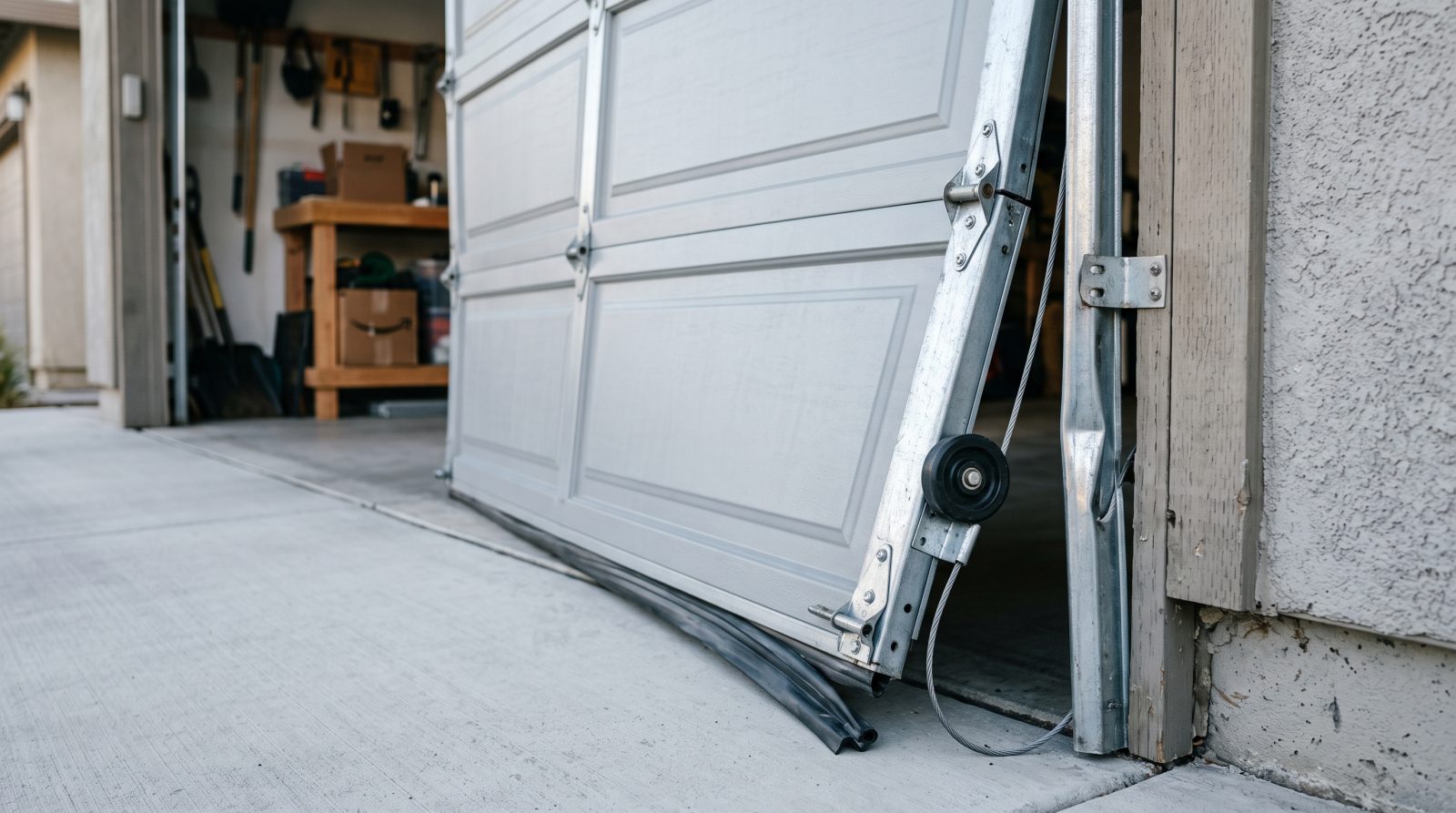
Your garage door rides on rollers that sit inside two vertical and horizontal steel tracks, one on each side. Those tracks guide the door smoothly up and over as the springs counterbalance the weight and the opener (or your arm) supplies the motion. "Off-track" means one or more rollers have come out of the track channel, so the door is no longer being guided and supported the way it was engineered to be. Once that happens, the load is no longer balanced across both sides, and the door can bind, twist, or lean.
Off-track failures range from minor to severe. A single roller that has popped out at the top while the rest of the door is still captured is a relatively contained problem. A door where multiple rollers have jumped, a section has buckled, or one side has dropped several inches while the other stays put is a serious, potentially hazardous situation. The more the door has deformed, the more force is stored in the system and the more careful the repair has to be.
- The door looks crooked, tilted, or hangs lower on one side than the other
- You can see rollers sitting outside the track, or a track that is visibly bent, twisted, or pulled away from the wall
- The door is jammed partway and will not go fully up or down
- Loud popping, grinding, or banging happened right before it stuck
- There is a gap between the door and the track, or the door rubs hard against the frame
- The opener strains, hums, or reverses without moving the door normally
What knocks a garage door off its tracks
Doors rarely jump the track for no reason. There is almost always an underlying mechanical cause, and identifying it matters because simply popping the rollers back in without fixing the root issue usually means the door comes off again. The most common single cause is impact: backing a vehicle into the door, or bumping the lower section, can bend the track or knock rollers loose even when the dent looks minor. A broken lift cable is another frequent culprit. When a cable snaps or slips off its drum, one side of the door loses support and drops, dragging that side's rollers out of alignment.
Worn or damaged hardware is a slower, sneakier cause. Rollers wear out, especially inexpensive plastic ones, and a seized or crumbling roller can hop the track. Loose track brackets let the rails drift out of position over time. Bent or rusted tracks no longer hold a clean channel. A door that has been running rough, scraping, or shuddering for weeks is often warning you before it finally comes off.
Climate plays a real role and varies by region. In cold, snowy areas the bottom of the door can freeze to the slab; forcing it open with the opener can rip rollers out or bend the bottom track. In humid coastal regions, salt air accelerates rust on tracks and hardware. In hot, dry climates, dust and grit build up in the tracks and dry out lubrication, increasing friction and wear. None of this changes the fundamentals, but it does mean maintenance needs differ depending on where you live.
- Vehicle impact or a hard bump bending the track or lower section
- A broken or slipped lift cable letting one side drop
- Worn, cracked, or seized rollers jumping the channel
- Loose, shifted, or under-tightened track brackets
- Bent, rusted, or kinked track from age, corrosion, or prior damage
- An obstruction left in the track's path, or a door frozen to the floor in winter
- A failing or unbalanced spring system putting uneven load on the door
Why you should never force an off-track door
It is tempting to grab the door and muscle it back into place, or to keep hitting the opener button until it moves. Please don't. An off-track door is a system that is no longer balanced, and a garage door is heavy enough to cause serious injury. Forcing it can pull more rollers out, bend additional track, buckle a panel, or send the door crashing down.
The bigger hidden danger is the spring and cable system. Garage door springs hold an enormous amount of stored energy to counterbalance the door's weight. When a door is off-track, that energy may be loaded unevenly, and the cables may be partially detached or under abnormal tension. Disturbing the door, prying at the rollers, or trying to disconnect things in the wrong order can release that force suddenly. This is the part of the door that injures people, which is why spring and cable work in particular should be left to trained technicians with the right tools.
Operating the opener on a jammed door also risks burning out the opener motor or stripping its gears, turning a track problem into a track-plus-opener problem. The safest and usually cheapest path is to stop, secure the door, and bring in a pro. Forcing it almost never saves money once you add up the extra damage.
- Do NOT keep pressing the opener button trying to free a stuck door
- Do NOT try to lift, pry, or pull the door back onto the track yourself
- Do NOT attempt to adjust, loosen, or remove springs or cables
- If the door is partly open, keep people, pets, and vehicles out from under it
- If you can do so safely without reaching into the springs, unplug the opener so no one cycles it
- Block the area and wait for a technician rather than risking the door dropping
What a proper off-track repair involves
When a qualified technician arrives, the first step is assessment, not action. They will look at how many rollers are out, whether tracks are bent, whether cables are intact and seated, and what the springs are doing. This tells them how much stored energy is in the system and the safe order of operations. A good tech secures the door before touching the rollers, often using clamps or vise grips on the track to prevent the door from moving unexpectedly.
From there the repair typically means carefully relieving tension or supporting the door, guiding the rollers back into the track, straightening or replacing any bent track sections, and re-seating or replacing cables if they came off. The technician then re-tightens and realigns track brackets, checks roller condition and replaces worn ones, and confirms the springs are intact and properly tensioned so the door is balanced again. Finally they cycle the door several times, check that it travels straight, and reset opener force and travel limits if needed.
A repair is only finished when the root cause is addressed. If a worn roller caused it, replacing that one roller while ignoring the rest just delays the next failure. If a cable slipped because the door is out of balance, re-seating the cable without correcting the balance invites a repeat. Replacement parts and labor for an off-track repair commonly fall into a moderate range, but the actual figure depends heavily on whether tracks or panels are bent, how many rollers and cables need replacing, the door's size and weight, and your region's labor rates. Any number you see online should be treated as a typical industry estimate, not a quote; a technician can give you a real price once they have seen the door.
- Inspection of rollers, tracks, cables, and springs before any adjustment
- Securing and supporting the door so it cannot move during the repair
- Re-seating rollers, straightening or replacing bent track, re-seating cables
- Realigning and tightening track brackets to spec
- Replacing worn rollers and damaged hardware, not just the failed part
- Re-balancing the door and resetting opener force and travel limits
- A test cycle to confirm smooth, straight, quiet travel
Preventing the next off-track failure
Most off-track events are preventable with light, consistent attention. The single most valuable habit is to listen to your door. Garage doors usually warn you before they fail: new grinding, scraping, popping, or a door that catches or shudders is a signal to have it looked at while the fix is still small. Acting on those early symptoms is far cheaper than waiting for the door to actually jump the track.
Routine care keeps the tracks doing their job. Keep the track channels clear of debris, leaves, and grit, and wipe them out periodically. Lubricate the rollers, hinges, and springs with a proper garage door lubricant a couple of times a year, more often in dusty or salty climates. Periodically check that the track brackets are snug and the track is not pulling away from the wall. If you have brittle plastic rollers, upgrading to better-quality nylon rollers reduces friction and the chance of one hopping the track.
Finally, protect the door from the most common trigger of all: impact. Be deliberate about vehicle clearance, never start the opener until the door is fully visible and clear, and don't try to force a door that feels frozen or stuck in cold weather. An annual professional tune-up, which checks balance, springs, cables, rollers, and track alignment in one visit, is the most reliable way to catch problems early no matter what climate you live in.
- Treat any new grinding, scraping, popping, or catching as an early warning
- Keep tracks clear of debris and lubricate rollers, hinges, and springs seasonally
- Check that track brackets are tight and tracks aren't drifting from the wall
- Upgrade brittle rollers to quality nylon ones to cut friction
- Mind vehicle clearance and never start the opener on a partly visible door
- In winter, never force a door that may be frozen to the slab
- Schedule a periodic professional tune-up to catch issues before they become failures