Fast Diagnosis, Then a Local Pro at Your Door
Most garage door emergencies come down to a handful of failure points, and knowing which one you're dealing with changes everything: how urgent it is, whether it's safe to touch, and how much it should cost to fix. The fastest path to a working door is an accurate diagnosis, not a random part swap. That's why we lead with helping you identify the symptom first, then matching you with a local technician who carries the right springs, rollers, and opener parts to finish the job in a single visit instead of a string of return trips.
Convenience is the whole point. You shouldn't have to call ten shops, compare vague phone quotes, and wait days while your car sits trapped or your home sits unsecured. Garage door hardware is broadly standardized across the country, so the same core repairs apply whether you're in a humid coastal town, a high-altitude mountain suburb, or a dry desert metro. We connect you with pros who service your specific area and understand the local conditions that wear doors down differently from one region to the next.
When you reach out, you'll get straightforward help narrowing down the issue and a route to same-day or fast local service in most areas. No pressure, no inflated 'whole new door' upsell when a single spring is the real culprit.
- Spring failure: the door is suddenly extremely heavy, won't open, or you heard a loud bang like a firecracker from the garage
- Opener trouble: the motor hums but the door won't move, the remote is dead, or the door reverses for no reason
- Off-track: the door is crooked, jammed at an angle, or a roller has popped out of the metal track
- Cable problems: a frayed or snapped cable hanging loose, or the door sitting lopsided on one side
- Noisy operation: grinding, squealing, or rattling that signals worn rollers, loose hardware, or dry parts
Broken Garage Door Springs: The Most Common (and Most Misunderstood) Failure
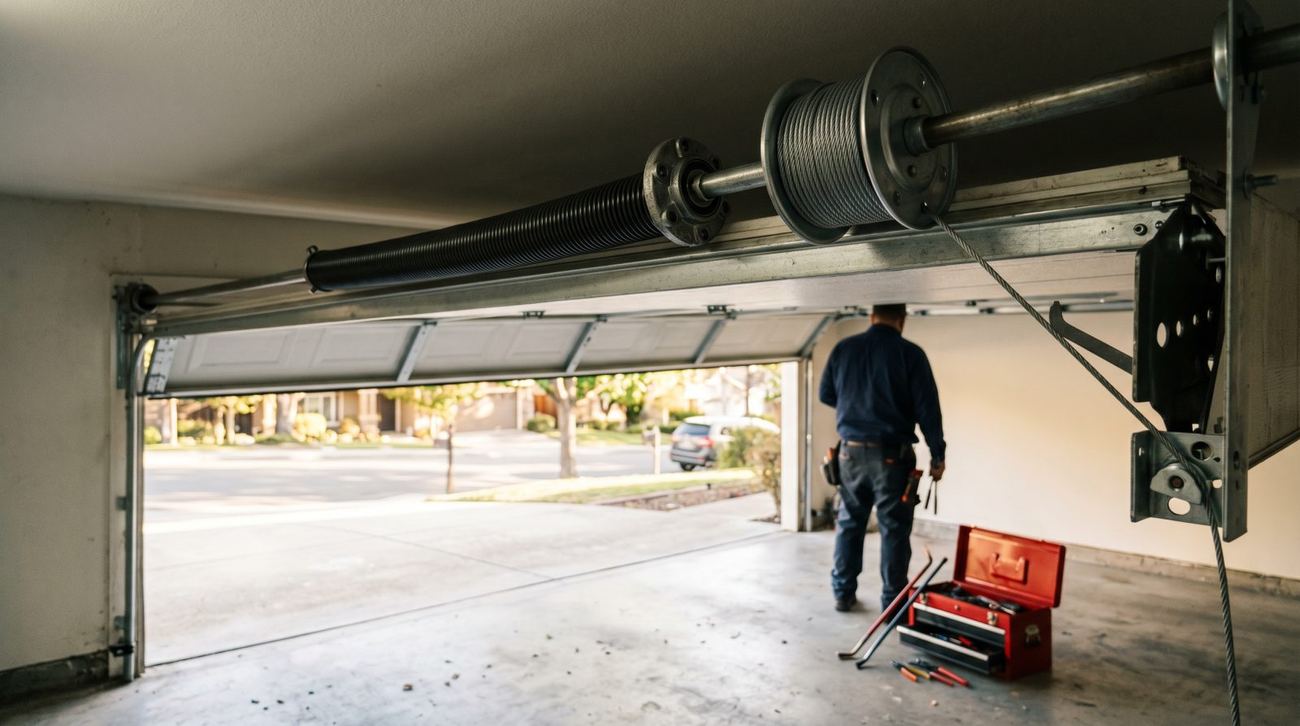
Springs do the heavy lifting in a garage door system, literally. A typical residential door weighs well over a hundred pounds, and it's the counterbalance springs, not the opener motor, that make it feel light enough to lift. The opener mostly just guides a door the springs have already balanced. So when a spring breaks, the door becomes a dead weight, the opener strains and stalls, and you're effectively stuck.
There are two main types. Torsion springs mount on a metal bar above the door opening and are the most common on modern doors. Extension springs run along the horizontal tracks on either side. Both are wound under enormous tension, storing enough force to cause serious injury if they let go or are handled incorrectly. The telltale signs of a break are a door that suddenly won't open, a loud bang heard earlier in the day, a visible gap in the coil of a torsion spring, or a door that crashes down instead of easing closed.
This is the clearest 'call a professional' situation on the list. Spring replacement requires special winding bars, correct spring sizing for your door's weight, and experience to release and reload that tension safely. It is genuinely one of the leading causes of garage-door injuries among well-meaning DIYers. Springs also tend to fail in cold snaps, since steel gets more brittle as temperatures drop, which is why repair calls spike during the first hard freeze of the season in colder regions.
- Door won't open and feels like it weighs a ton, or the opener strains and gives up
- You heard a sharp bang from the garage but everything looked fine until you tried the door
- Visible gap or separation in the tightly wound torsion spring above the door
- A safe-and-smart move: stop using the opener so you don't burn out the motor forcing a broken door
Garage Door Openers and Remotes: Why It Won't Respond
Opener problems range from the trivial to the genuinely broken, and many are worth a two-minute homeowner check before you call anyone. If the wall button works but the remote doesn't, it's often just a dead remote battery or a remote that lost its programming. If nothing responds at all, confirm the opener has power: a tripped breaker, an unplugged unit, or an engaged vacation lock-out switch on the wall console are surprisingly common 'repairs.'
One issue worth understanding is the safety reversal system. Federal safety rules require automatic doors to reverse when something crosses their path, sensed by a pair of photo-eye sensors mounted a few inches above the floor on each track. If your door starts down and rolls right back up, the most likely cause is a dirty or knocked-out-of-alignment sensor, not a failed motor. Wiping the lenses clean and making sure they point straight at each other resolves a large share of these calls. Most sensors have a small indicator light that glows steady when aligned.
When the simple checks don't do it, the culprit may be a worn drive gear, a failing logic board, a stripped trolley, or a motor at the end of its life. Openers generally last many years, and a unit that's old, loud, and increasingly unreliable is often more economical to replace than to keep patching, especially since newer models add quieter belt drives, battery backup, and smartphone control. A technician can tell you honestly whether a repair or a replacement is the better value for your situation.
- Remote dead but wall button works: try a fresh remote battery, then reprogram the remote
- Nothing responds: check the breaker, the plug, and the lock/vacation switch on the wall console
- Door reverses before closing: clean and realign the photo-eye sensors near the floor
- Motor hums but door won't move: often a stripped gear or broken trolley, a job for a pro
Off-Track Doors and Snapped Cables: Stop Before You Make It Worse
An off-track door is one of the most alarming-looking failures and one of the easiest to turn from a moderate repair into an expensive one. It happens when a roller jumps out of the metal track, often after the door hits an obstruction, a cable slips, or a roller or track bracket wears out. The door ends up crooked, jammed at an angle, or hanging precariously, and the natural instinct is to force it back into place or keep hitting the opener button. Don't. Forcing an off-track door can bend panels, snap cables, or bring the door down.
Cables work hand in hand with the springs to control the door's descent and keep both sides moving evenly. When a cable frays or snaps, you'll often see the door sitting lopsided, a loose cable dangling near the bottom bracket, or the door drifting and binding as it moves. Like springs, the lift cables are under high tension, especially the ones anchored at the bottom corners of the door. Disconnecting or adjusting them without releasing the spring tension first is dangerous.
For both off-track doors and cable failures, the safest first step is to stop operating the door and disengage the opener using the red emergency release cord, but only if the door is fully closed and you can do so without standing under a raised, unstable door. Then get a technician out to reset the rollers, replace damaged cables, and inspect the springs and brackets that likely contributed to the failure. A proper repair fixes the root cause, not just the symptom, so the same panel doesn't pop off again next month.
- Door is crooked, jammed at an angle, or a roller is clearly out of its track
- Loose, frayed, or hanging cable, or a door that sits noticeably lower on one side
- Resist the urge to force it or keep pressing the opener, which compounds the damage
- If the door is fully closed, disengage the opener and wait for a pro rather than improvising
What Garage Door Repairs Typically Cost
Pricing always depends on your specific door, the parts involved, the materials, and your region, so treat the following as typical industry estimate ranges rather than a quote or a guarantee. Your local technician will confirm pricing after seeing the door, and a reputable pro should give you a clear figure before starting work.
As a general guide, common spring replacements often land in roughly the $150 to $350 range depending on spring type and whether one or both are replaced (many pros recommend replacing springs in pairs since they wear together). Opener repairs commonly run about $100 to $300, while a full opener replacement, including a new motor unit, typically falls in the $300 to $600+ range depending on the model and features. Roller and cable replacements are often among the more affordable fixes, frequently in the $100 to $250 range. A full new door installation varies the most, anywhere from around $700 for a basic single door to several thousand dollars for an insulated, custom, or two-car carriage-style door.
Costs also shift by region and conditions. Labor rates run higher in major metros, and climate plays a real role in wear: coastal salt air accelerates rust on springs and hardware, freeze-thaw cycles in northern states stress springs and openers, and intense sun and heat in desert regions can degrade weather seals and finishes faster. The honest takeaway is that a fast, accurate diagnosis usually saves money, because catching a worn cable or fraying spring early is far cheaper than waiting for it to take out the panels or the opener with it.
- Spring replacement: roughly $150 to $350 (estimates vary; pairs often recommended)
- Opener repair: roughly $100 to $300; full opener replacement roughly $300 to $600+
- Rollers and cables: often roughly $100 to $250, among the more affordable fixes
- New door installation: from around $700 for basic up to several thousand for insulated or custom
- All figures are typical estimate ranges that vary by door, materials, scope, and region