What a Roll-Up Garage Door Actually Is (and Why It's Different)
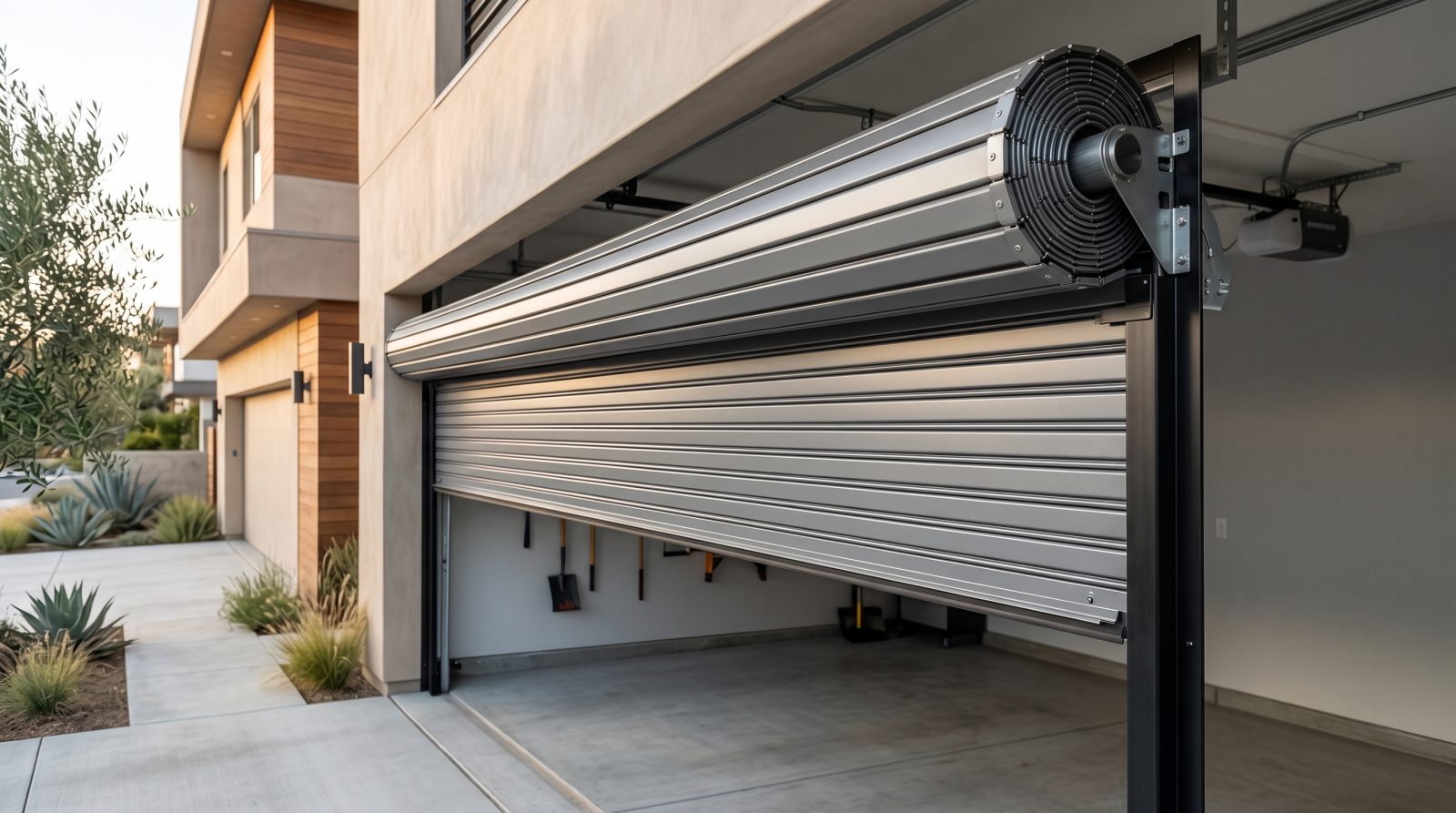
Roll-up doors, also called coiling doors, are built from narrow horizontal slats that hinge together into a flexible curtain. When the door opens, that curtain wraps around a steel barrel mounted above the opening rather than gliding back along horizontal ceiling tracks. The whole assembly lives in a compact zone right at the header, which is exactly why these doors are so popular where space is tight: commercial bays, loading docks, parking structures, storage facilities, and increasingly compact urban and infill homes where there's no room overhead for a sectional door to park.
There are two broad families. Heavier service doors use thick interlocking steel slats riding in side guides and counterbalanced by a torsion spring inside the barrel. Lighter sheet-curtain doors, common on self-storage and small sheds, use a thin corrugated curtain and a simpler spring. Both share the same fundamental geometry, but the parts, the spring tension, and the repair approach scale dramatically with the door's size and weight. Knowing which type you have is the first step to diagnosing it correctly.
Because the curtain rides in side guides instead of rollers in a track, roll-up doors tolerate dust, debris, and rough handling better than sectional doors, which is part of why they dominate commercial settings. The tradeoff is that when a roll-up door fails, the failure is often inside the barrel or the guides where it's harder to see and far more dangerous to touch. That's the central thing to keep in mind throughout this page.
- Curtain coils into a barrel overhead instead of sliding back on ceiling tracks
- Two main types: heavy interlocking-slat service doors and lighter sheet-curtain doors
- Side guides replace the rollers and horizontal tracks of a sectional door
- Common on commercial bays, storage units, and space-constrained homes
- Counterbalanced by a spring inside or behind the barrel, not by visible torsion springs above the opening
The Most Common Roll-Up Door Problems We Diagnose
Across the country, the same handful of failures account for most roll-up service calls, though how fast they show up varies with climate and use. The single most common is a curtain that won't roll up or down smoothly. Usually that traces back to the side guides: bent guides, debris packed into the channel, or a slat that has slipped out of the guide and bound the whole curtain. On heavily used commercial doors, repeated impacts from forklifts, carts, or vehicles bend the bottom slats and guides over time until the door drags or jams.
The second big category is spring and counterbalance failure. A roll-up door's spring lives inside the barrel and carries enormous tension to offset the curtain's weight. When it weakens or breaks, the door suddenly feels extremely heavy, won't stay open, slams down, or refuses to lift at all. This is the most dangerous failure on the door, and it is not a homeowner repair. A barrel spring under load can cause serious injury if disturbed without the right tools and training.
The third cluster involves the slats and curtain themselves: bent, cracked, or rusted slats, a curtain that has gone crooked in the opening, or interlocks that have spread apart. Climate plays a real role here. In coastal and humid regions, salt air and moisture accelerate rust on steel curtains and guides. In cold northern climates, ice can freeze the bottom slat to the floor and the curtain into the guides, and forcing a frozen door is a classic way to bend slats or strip an opener. In hot, dusty regions, grit accumulates in the guides and dries out lubrication faster, so doors get noisy and sticky sooner. Finally, motorized roll-up doors add opener, motor, chain, and limit-switch faults on top of all the mechanical issues a manual door can have.
- Door won't roll smoothly: bent or debris-clogged side guides, or a slat slipped out of the guide
- Sudden heaviness, slamming, or won't lift: barrel spring weak or broken (pro-only)
- Bent or cracked slats from impacts, especially on commercial bottom slats
- Rust and corrosion on slats and guides in humid or coastal climates
- Frozen curtain or bottom slat in cold climates; never force a frozen door
- Noisy, sticky operation from dust and dried-out lubrication in arid regions
- Opener faults on motorized doors: motor, chain, limit switches, and remotes
Fast At-Home Diagnosis: What to Check Before You Call
A few minutes of careful observation will tell you a lot and helps a local pro arrive prepared. Start by watching and listening as you operate the door, or as someone else does. Where exactly does it stick? Is the resistance at the bottom, in the middle of travel, or near the top as the curtain enters the barrel? A door that binds in one spot usually has a localized guide or slat problem, while a door that's heavy through the entire travel points toward the spring and counterbalance.
Next, do a safe visual scan with the door fully down and the opener disconnected on motorized units. Look at the side guides for visible bends, dents, or packed-in debris and pull out any obvious loose grit or leaves by hand. Check the bottom slat for impact damage and look along the curtain for cracked, separated, or badly rusted slats. If the door is frozen, do not force it; let it thaw or apply gentle warmth rather than fighting it with the opener, which can bend slats or burn out a motor.
Here is the hard line: do not attempt to adjust, loosen, or 'fix' the spring or barrel yourself. Unlike a sectional door's visible torsion spring, a roll-up door's counterbalance is concealed and pre-tensioned, and there's often no safe way for an untrained person to even tell how much load it's holding. If the door is suddenly heavy, slams, or won't stay up, stop using it and get a professional. Forcing a door with a failing spring risks both a serious injury and turning a single-part repair into a full curtain or barrel replacement.
- Note exactly where the door sticks: bottom, mid-travel, or entering the barrel
- Heavy through the whole travel usually means a spring/counterbalance problem
- Disconnect a motorized opener before inspecting, then clear visible debris from guides
- Inspect the bottom slat and curtain for bends, cracks, separation, and rust
- Never force a frozen door with the opener; let it thaw first
- Do not touch, loosen, or adjust the barrel spring; that is a pro-only repair
DIY vs. Pro: Where the Line Really Is
Plenty of roll-up door maintenance is genuinely homeowner- or facility-friendly, and doing it regularly prevents the expensive failures. Cleaning the side guides, removing debris, wiping down the curtain, and applying the right lubricant to the guides and moving parts are all reasonable to do yourself. Keeping the area around the bottom slat clear and addressing surface rust early with appropriate products will meaningfully extend the door's life, especially in harsh climates.
The work that should go to a trained technician centers on anything under load or anything that affects how the door is balanced and sealed. That includes spring and counterbalance service or replacement, re-tensioning the barrel, replacing or straightening bent slats and guides, realigning a crooked curtain, and any structural work where the door meets the opening. Motor and opener repair, limit-switch and safety-reversal adjustment, and chain or operator service on commercial doors also belong with a pro, both for safety and because misadjusted limits and reversals are a real hazard.
For commercial and high-cycle doors, there's an additional reason to lean on professionals: downtime costs money and a half-finished repair can leave a bay unusable. A pro can often diagnose on site, carry common slats and spring components, and get the door back in service the same day. The goal of this site is to connect you with that local help quickly, wherever you are, rather than leaving you to guess at a repair that could make the problem worse.
- Reasonable DIY: cleaning guides, clearing debris, lubrication, surface-rust care, keeping the opening clear
- Pro-only: spring/counterbalance work, barrel re-tensioning, slat and guide replacement
- Pro-only: realigning a crooked curtain and any structural work at the opening
- Pro-only: opener, motor, chain, limit-switch, and safety-reversal service
- High-cycle commercial doors benefit most from fast on-site diagnosis to limit downtime
What Roll-Up Repair and Replacement Typically Cost
Pricing for roll-up door work spans a very wide range because the doors themselves do, from a small residential or storage-unit curtain to a heavy industrial coiling door. The figures below are typical industry ranges and rough estimates only; they are not a quote or a guarantee, and your actual price depends on the door's size and type, the material and slat gauge, the parts involved, your region, and the scope of work. Always get an on-site assessment for a real number.
As a general guide, smaller service items such as guide cleaning, lubrication, minor realignment, or a basic tune-up tend to fall at the lower end. Replacing damaged slats or sections of curtain, straightening or swapping guides, and spring or counterbalance replacement sit in the middle and climb with door size and weight, because larger doors use heavier springs and more material. A full curtain or complete door replacement is the most significant expense, and commercial and oversized industrial doors run substantially higher than compact residential units for the same category of work.
Two factors push roll-up costs up that owners often underestimate. First, weight and access: big commercial doors may require more than one technician and specialized handling, which affects labor. Second, deferred damage: a single failed spring left in service can fatigue and bend an entire curtain, turning a moderate spring repair into a far larger replacement. Catching problems early, and not forcing a struggling door, is the most reliable way to keep costs in the lower ranges. When in doubt, request a free quote so you're comparing a real scope, not a guess.
- All figures are typical industry ranges and estimates, not quotes or guarantees
- Cost drivers: door size and type, slat material and gauge, parts, region, and scope
- Lower end: cleaning, lubrication, minor realignment, and basic tune-ups
- Mid range: slat or curtain-section replacement, guide work, spring/counterbalance replacement
- Highest: full curtain or complete door replacement, especially large commercial and industrial doors
- Early repair prevents a small spring fault from cascading into a full curtain replacement