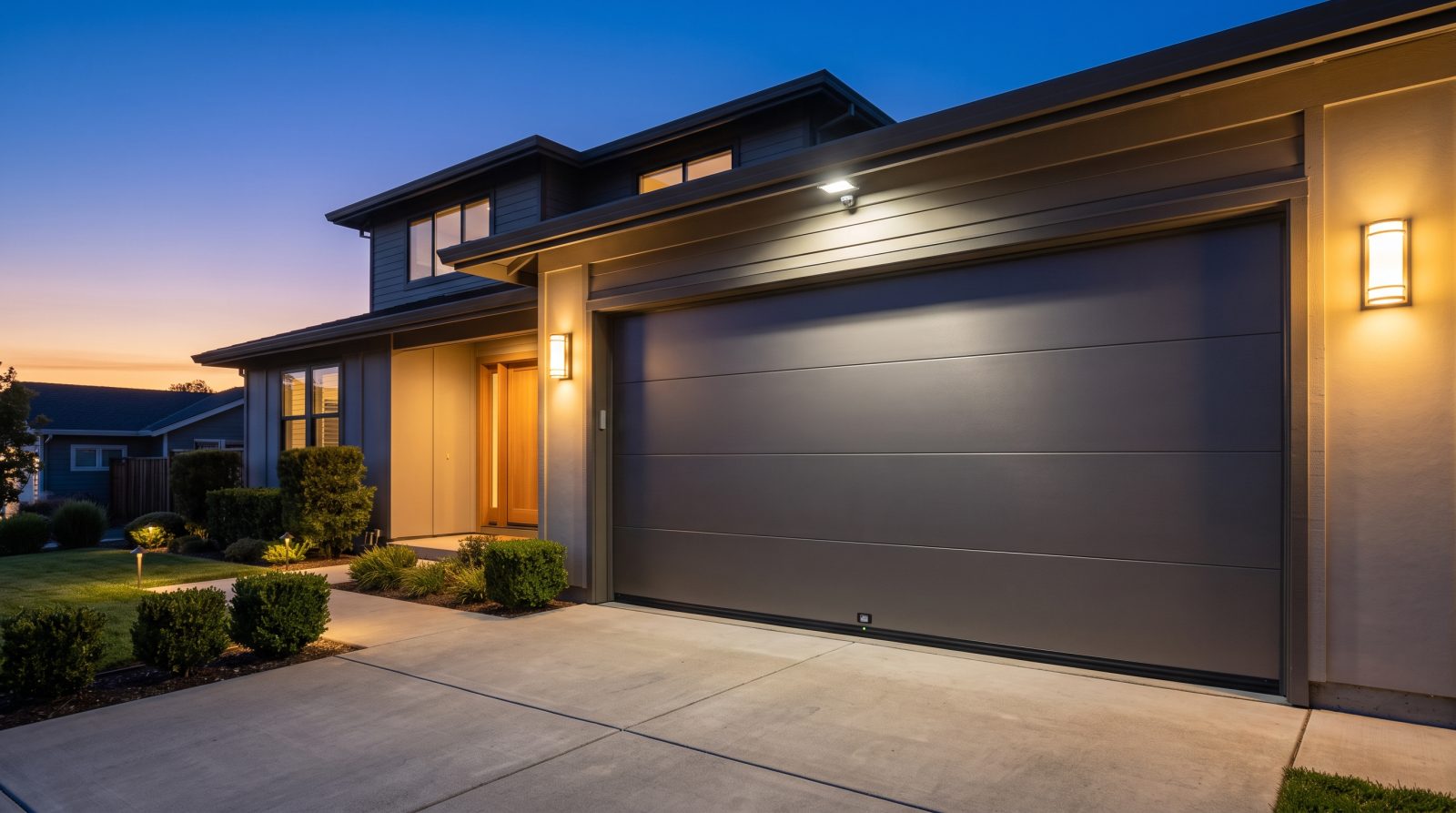
Why the Garage Is the House's Weakest Link
Most break-ins are crimes of opportunity. A burglar walks or drives a neighborhood looking for the path of least resistance, and the attached garage checks almost every box: it's set back from the street, partly screened by the driveway and landscaping, dark after sunset, and it hides what they're doing once they're inside. Get through the overhead door and they're working out of sight, with your tools, ladders, and a likely-unlocked door into the kitchen.
There are really three doors to think about, and each fails differently. The overhead sectional door is large and can be forced, lifted, or defeated through its own safety release. The connecting door between the garage and the living space is the last line of defense and is too often a hollow, unlocked builder-grade door. And if your garage has a side service door or windows, those are simple pry-and-pop targets. A genuinely secure garage addresses all three — hardening only the big door while leaving the interior door unlocked just moves the weak point.
None of this requires paranoia or an expensive system. It requires closing the specific gaps attackers actually use, in roughly the order of how easy they are to exploit.
- The overhead door: vulnerable to the emergency-release attack, forced lifting, and off-track prying
- The connecting (house) door: often hollow-core and unlocked — the real prize for an intruder
- Service doors and windows: easy pry points if hinges, glass, or latches are weak
- Habits and visibility: an open or cracked door and dark surroundings advertise opportunity
Shut Down the #1 Weakness: The Emergency-Release Attack
Every automatic garage door has a red emergency-release cord hanging from the trolley so you can disengage the opener and lift the door by hand during a power outage. It's a genuine safety feature — and also the single most exploited garage vulnerability. The classic method: an intruder slips a coat hanger or thin rod through the small gap at the top of the door, hooks the release cord, pulls, and the door is now free to lift open. On many doors this takes well under a minute and leaves no damage.
The fix is cheap and fast. First, if your release cord has a plastic handle dangling low, shorten it so there's nothing easy to snag — you only need enough cord to reach by hand. Second, install a release-lock shield (often called a garage door shield, with the zip-tie method as a temporary stopgap) that blocks a hooked tool from grabbing the trolley; purpose-built brackets are inexpensive and bolt right on. Third, close the gap at the top of the door with a weather seal or a simple shield plate so a tool can't be fished through in the first place.
If your opener is more than a decade old, consider that newer systems often integrate better against this attack and add rolling-code remotes (more on that below). When in doubt about whether your specific trolley and release can be secured safely without disabling the emergency function, that's a quick question for a local garage door tech — you never want to defeat the manual release so completely that you can't get out in a real emergency.
- Shorten the emergency-release cord so there's no low, snaggable handle
- Add a release-lock shield or guard bracket to block a hooked tool from the trolley
- Seal the gap at the top of the door so a hanger can't be fished through
- Test the manual release afterward — security must never trap you inside during an outage
Secure the Opener, Remotes, and Keypad
The electronics are a second attack surface. Older openers used fixed codes that could be captured and replayed with a cheap device — newer openers use rolling-code (hopping-code) technology that generates a fresh code every press, which largely closes that door. If you don't know which you have, an upgrade or a rolling-code conversion is one of the higher-value security improvements you can make, and it's a routine job for a pro.
Remotes themselves are a quieter risk. A remote clipped to the visor of a car parked in the driveway is a free key to your home — break the car window, grab the remote, and the garage (and often the house) is open. Keep remotes out of sight, and strongly consider a keychain remote or a smartphone-app opener instead of the visor clip. If a remote or car is ever stolen, reprogram the opener immediately; most units let you erase all paired remotes and re-pair only the ones you keep.
Wireless keypads on the exterior are convenient, especially for kids and deliveries, but treat the PIN like a house key. Choose a non-obvious code, change it periodically, and use any temporary-code feature for one-off access instead of sharing your permanent PIN. If your opener supports it, enable the auto-close timer so a door left up after a busy morning doesn't sit open and invite trouble — and Wi-Fi-enabled openers can alert your phone when the door opens or has been left open.
- Upgrade older fixed-code openers to rolling-code, or convert if possible
- Never leave a remote clipped in a car visible from outside — use a keychain or app
- Reprogram/erase all remotes after a theft or when selling the home
- Pick a strong keypad PIN, change it periodically, and use temporary codes for guests
- Enable auto-close and open-alerts on smart openers so a door is never left up unnoticed
Harden the Physical Door and Track
Beyond electronics, the door's mechanics can be reinforced. The simplest deterrent is a manual lock used when you're away for a stretch — many sectional doors accept side-mounted slide locks or a T-handle lock that physically pins the door to the track. There are also automatic deadbolt-style locks that engage the track when the door closes. For maximum security on travel days, you can disengage the opener and throw a manual lock, which defeats both the release-cord trick and any electronic attack at once.
Forced entry is the other concern. A door in poor repair is easier to breach: worn rollers, loose track bolts, frayed or broken cables, and weak or aging hinges all make a door easier to pry, lift, or knock off its track. This is where security and basic repair overlap directly — a door that's properly tensioned, with sound springs, tight track, and good rollers, simply resists abuse better than one that's already half-failing. If your door rattles loosely, sags, struggles to seal at the bottom, or has visible gaps, those are both safety and security issues worth a same-day look from a local tech.
Service doors and garage windows deserve the same scrutiny you'd give any exterior door: a solid-core door with a deadbolt and reinforced strike plate, hinges that can't be lifted, and frosted or covered windows so no one can scout your tools and valuables. Don't forget the connecting door into the house — make it solid-core, fit it with a real deadbolt, and lock it every time. It is your last line of defense, and it's the one most people ignore.
- Add a manual slide/T-handle lock or an automatic track lock for time away
- Keep the door mechanically sound — tight track, good rollers, sound springs and cables resist forced entry
- Treat the side service door like a front door: solid-core, deadbolt, reinforced strike, non-removable hinges
- Cover or frost garage windows so valuables and your daily schedule aren't on display
- Make the connecting interior door solid-core, deadbolted, and locked every single time
Lighting, Habits, and Smart Monitoring
A surprising amount of garage security is free. The biggest single habit is simply keeping the door closed — a cracked or open door is an open invitation, and many burglaries through garages start with a door left up 'just for a few minutes.' Build a closing routine, and if you're forgetful, let technology back you up with an auto-close timer or a smart opener that pings your phone.
Visibility is a deterrent because criminals prefer the dark and the unseen. Motion-activated lighting on the driveway and over the service door, trimmed landscaping that doesn't screen the approach, and a camera or video doorbell covering the garage approach all raise the effort and risk for an intruder. You don't need a professional system to start — a couple of motion lights and a single well-placed camera change the calculus.
Finally, don't make the garage a billboard. An expensive bike, a wall of tools, or a high-end car visible every time the door rolls up tells passersby exactly what's inside. Keep valuables out of direct sightline, lock the most tempting items, and consider where you park. Layered together — a closed and sound door, a locked interior door, good lighting, and a little monitoring — these steps push your home well past the easy-target threshold most opportunistic burglars are looking for.
- Keep the door closed by default; use auto-close timers and open-alerts as a safety net
- Add motion lighting over the driveway and service door, and a camera covering the approach
- Trim shrubs and screens so the garage approach is visible from the street and neighbors
- Keep high-value items out of sightline when the door is open — don't advertise the contents
Does Climate or Region Change Anything?
The core security playbook is the same everywhere, but a few details shift with climate and region. In hot, humid, and coastal areas, hardware corrodes faster — track bolts, lock mechanisms, hinges, and strike plates can seize or weaken, so security hardware needs occasional inspection and corrosion-resistant fittings hold up better. In cold-winter regions, weather seals stiffen and gaps can open up at the top and bottom of the door as materials contract, which is exactly the gap an emergency-release tool exploits, so seasonal seal checks do double duty for warmth and security.
Where storms or high winds are common, doors are sometimes upgraded for impact and wind resistance, and a well-braced, reinforced door is also harder to force or peel back. In drier climates, dust and grit accelerate wear on rollers and tracks, and a poorly maintained track makes a door easier to knock off its rails. The throughline is that a maintained door is a more secure door — the same upkeep that prevents breakdowns also removes the slack and weakness an intruder would exploit.
If you're not sure how your specific door, opener, and region stack up, a local pro can assess all three doors, your release mechanism, and your hardware in one visit and point out which fixes matter most for where you live. Wherever you are, you can request a free quote and get a knowledgeable set of eyes on your setup quickly.
- Humid/coastal: expect faster corrosion — inspect and choose corrosion-resistant hardware
- Cold climates: re-check seals seasonally so contraction gaps don't open at the top of the door
- Storm-prone areas: impact/wind-rated and well-braced doors also resist forced entry
- Dry/dusty regions: keep tracks and rollers clean so the door can't be knocked off its rails