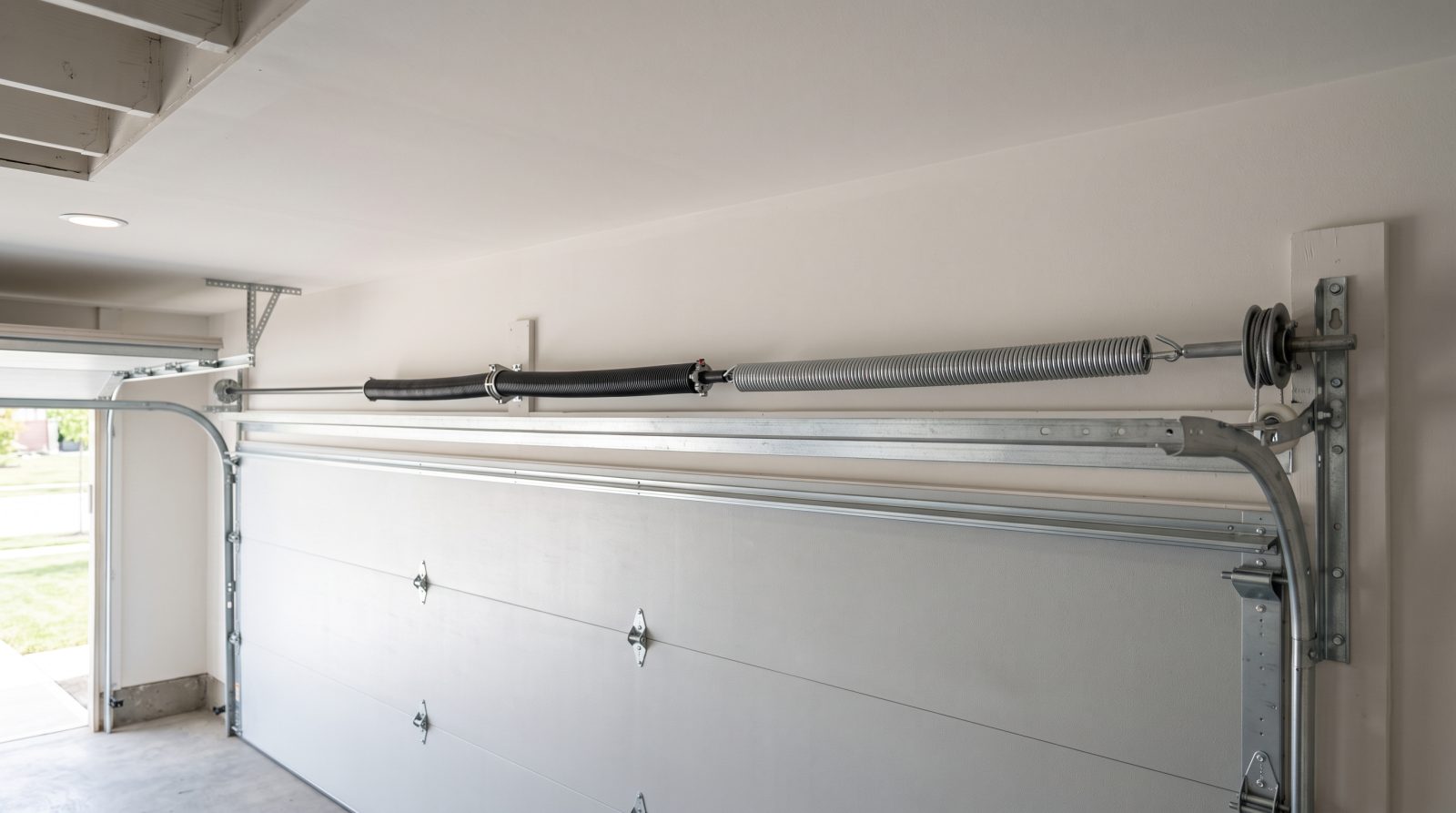
How Garage Door Springs Actually Work
Your garage door doesn't lift itself by motor power alone. The opener is mostly there to guide the door and hold it in place; the real lifting is done by springs that store mechanical energy. When the door is down, the springs are loaded with tension. As the door opens, that stored energy is released to counterbalance the weight, which is why a properly balanced door feels almost weightless when you lift it by hand. This counterbalancing is the entire job of the spring, and it's why a single failed spring can make even a powerful opener strain, grind, or refuse to lift at all.
Because springs carry the full load of the door thousands of times, they're rated in cycles rather than years. One cycle is one full open and one full close. A standard residential spring is commonly rated for roughly 10,000 cycles, which is why a household that opens the door several times a day will often see a spring reach the end of its life in a handful of years, while a rarely-used door may last much longer. Higher-cycle springs rated for 15,000, 20,000, or more exist and are a smart upgrade for busy households, but the original springs on most doors are the standard-duty type.
The key takeaway is that springs are wear parts with a finite lifespan, not permanent hardware. They don't fail because something went wrong, they fail because they did their job a certain number of times. Knowing which type your door uses is the first step to understanding how yours will eventually wear out and what the fix involves.
- A balanced door should hold its position when stopped halfway by hand, neither slamming down nor flying up
- Springs are rated by cycles, not age; usage frequency is the biggest factor in lifespan
- The opener guides and latches the door, but the springs do the heavy lifting
- A worn or broken spring forces the opener to overwork, shortening its life too
Torsion Springs: The Workhorse Above the Door
Torsion springs are the heavy, tightly wound coils mounted horizontally on a metal shaft above the door opening, usually centered or sometimes paired on either side. When the door closes, cables attached to the bottom corners wind around drums on each end of that shaft, twisting the spring and loading it with torque. When the door opens, the spring unwinds and that torque turns the shaft, winding the cables and lifting the door. It's a controlled, balanced system, which is why torsion setups tend to operate more smoothly and quietly than the alternative.
Torsion systems are the more common choice on modern doors and on heavier doors, including insulated and double-car doors, because they distribute the lifting force evenly and last longer under load. Most residential doors use one or two torsion springs depending on door size and weight; bigger or heavier doors often need two for proper balance. The springs are sized very specifically to the exact weight of your door, which is one of the main reasons replacement is a precision job rather than a grab-anything-that-fits swap.
The trade-off is that torsion springs hold an enormous amount of stored energy in a compact space, and they're under tension even when the door is closed. The same design that makes them smooth and durable also makes them dangerous to anyone without the right winding bars, training, and technique. A torsion spring that's improperly unwound or that slips during service can release that energy violently, which is exactly why this is a job for a pro.
- Mounted horizontally on a shaft above the door opening
- Smoother, quieter operation and longer typical lifespan than extension springs
- Preferred for heavier, insulated, and double-wide doors
- Sized to the precise weight of your specific door; not interchangeable by guesswork
- Replaced in matched pairs when a door uses two, so the system stays balanced
Extension Springs: The Stretch System on the Sides
Extension springs are the long, lighter-gauge springs that run horizontally along the upper tracks on each side of the door, parallel to the ceiling. Instead of twisting, they work by stretching. When the door closes, the springs extend and store energy through that stretch; when the door opens, they contract and pull the door up via a system of pulleys and cables. You'll most often find extension springs on older homes and on lighter, single-car doors where the simpler, lower-cost system was a natural fit.
Because extension springs expand and contract with each cycle, a properly installed extension system must include safety cables, which are thick cables threaded through the center of each spring and anchored at both ends. If an extension spring breaks under tension, it can otherwise launch across the garage with serious force. The safety cable contains that broken spring so it can't become a projectile. If your door uses extension springs and you don't see safety cables running through them, that's an urgent safety gap worth having a pro address.
Extension springs are typically less expensive up front, but they generally don't last as long as torsion springs under the same usage, and their pull can be slightly less balanced, which sometimes shows up as a door that opens unevenly or pulls to one side. They're always installed and replaced as a matched pair so both sides pull with equal force; replacing just one when the other is the same age usually means the second failure isn't far behind.
- Run horizontally along the tracks on both sides of the door
- Work by stretching and contracting rather than twisting
- Common on older homes and lighter single-car doors
- Must have safety cables installed to contain a break safely
- Always replaced as a matched pair to keep the door pulling evenly
Signs Your Spring Is Failing (And What to Do)
The most unmistakable sign is a loud bang from the garage, often when no one is even using the door, followed by a door that won't open or feels impossibly heavy. A broken torsion spring usually shows a clear gap in the coil, like the spring snapped in two, while a broken extension spring may hang loose or look obviously separated. If you see either, stop using the door entirely, including the opener, because forcing a door with a broken spring can damage the opener, bend the tracks, or cause the door to crash down.
Plenty of springs warn you before they fully fail. A door that suddenly feels heavy when lifted by hand, that opens partway and stops, that jerks or moves unevenly, or that closes faster than it used to can all point to a weakening spring losing tension. Gaps, rust, or visible stretching in the coils are also red flags. With torsion springs especially, you may notice the door struggling to lift even though the opener motor is running normally, because the opener simply can't make up for the lost counterbalance.
Climate plays a real role here. In colder regions, metal contracts and becomes more brittle, which is why so many springs let go on the first hard freeze of the year, often early in the morning. In humid or coastal areas, moisture and salt air accelerate rust, and a rusted spring fails earlier and more suddenly than a clean one. None of this changes the response: when a spring breaks or shows these warning signs, the safe move is to leave the door alone and get a qualified technician out to inspect and replace it. Spring repair involves releasing and re-tensioning hundreds of pounds of stored force, and it's consistently one of the most injury-prone garage door jobs for untrained hands.
- A loud bang followed by a door that won't lift, or a visible gap in the coil
- The door feels much heavier than usual when lifted by hand
- Uneven, jerky, or one-sided movement as it opens
- Gaps, rust, or visible stretching in the spring coils
- Cold snaps and coastal humidity both shorten spring life and trigger sudden breaks
- If a spring breaks, stop using the door and opener immediately, then call a pro
Repair, Replacement, and Cost Expectations
When a spring fails, the standard fix is replacement, not repair; springs aren't something you patch back to working order. A good technician will also check the matching components, because a spring failure rarely happens in isolation. Cables, drums, bearings, and rollers wear alongside the springs, and replacing a spring without inspecting the rest of the counterbalance system often just sets up the next failure. This is also the moment to ask about a higher-cycle spring upgrade if your household uses the door heavily, since the difference in lifespan can be substantial for a modest difference in part cost.
Pricing varies widely and should be treated as a typical industry range rather than a quote. As a general guide, residential spring replacement commonly falls somewhere in the range of roughly $200 to $500 including parts and labor, with the final figure depending on whether your door uses one spring or two, the spring type and cycle rating, door size and weight, and your region's labor rates. Doors that need two springs, oversized or heavy doors, and higher-cycle upgrades sit toward the upper end. Any honest pro will give you a firm number after seeing the actual door, since the right spring is sized to your specific setup.
A frequent question is whether to replace both springs when only one broke. On a two-spring door, replacing both at the same time is widely recommended, because the surviving spring has the same age and cycle count as the one that just failed and is likely close behind. Doing both in one visit avoids a second service call and keeps the door balanced. Whatever the configuration, the smartest path is a quick professional inspection that confirms the spring type, measures the door, and gets the right part installed safely. If your door is stuck, sounding off, or feeling heavy, request a free quote and get a local pro out to take a look before a small problem becomes a door that won't move at all.
- Springs are replaced, not repaired; ask the tech to inspect cables, drums, and rollers too
- Typical spring replacement ranges roughly $200 to $500, an estimate that varies by door, parts, and region
- One vs. two springs, cycle rating, and door weight all move the final price
- On two-spring doors, replacing both at once is usually the better value
- Consider a high-cycle upgrade if you use the door many times a day