Start Here: The 60-Second Safety and Power Check
Before assuming the worst, run through the quick checks that resolve a surprising share of "my garage door won't open" situations. These cost nothing, take about a minute, and they tell a technician (and you) a lot about what's actually wrong. Work through them in order and stop the moment the door behaves normally again.
First, figure out whether the problem is the opener (the motor unit) or the door itself. If you pull the red emergency release cord and can lift the door smoothly by hand, your door and springs are likely fine and the issue is electrical or with the opener. If the door is stuck, heavy, or won't budge by hand, do not force it; that points to a spring, cable, or track problem that needs hands-off caution.
A few of these checks lean on simple things people overlook under stress, like a wall switch lockout that was bumped on, or a remote that quietly died. Ruling them out first saves you time and may save you a service visit entirely.
- Confirm power: make sure the opener is plugged in and the outlet has power. Tripped breakers and GFCI outlets are extremely common culprits, especially after a storm or power flicker.
- Try the hardwired wall button, not just the remote. If the wall button works but the remote doesn't, the issue is the remote (often a dead battery), not the door.
- Check the photo-eye sensors near the floor on both sides. If they're misaligned or blocked, the door may refuse to close or behave erratically; wipe the lenses and make sure both indicator lights are steady.
- Look for a vacation or lockout switch on the wall console that may have been switched on, disabling the remotes.
- If you recently lost power, know that the opener won't run on its own; use the manual release to lift the door, then reset the opener once power is restored.
Decoding the Symptom: What Your Door Is Telling You
A door that won't open rarely fails silently; the specific way it fails usually narrows the cause down fast. Paying attention to what happens when you press the button is the single most useful thing you can report to a technician, and it often tells you how urgent the problem is.
If the opener motor hums or runs but the door doesn't move, the drive system or the door's connection to it is the likely suspect. This can be a stripped trolley, a disconnected emergency release that was pulled and never re-engaged, a broken belt or chain, or a torsion spring that has snapped, leaving the motor unable to lift the door's full weight. A motor that strains and reverses is frequently fighting a door that has become too heavy to lift, which points back to the springs.
If you hear nothing at all when you press the wall button, the problem is more likely electrical: power, a failed circuit board, a burned-out motor, or a wiring fault. And if the door starts to open then stops or reverses partway, the safety system is doing its job; that's typically a sensor, track obstruction, or travel-limit setting at work, not a failure of the door itself.
- Motor runs, door doesn't move: check the emergency release first, then suspect a broken spring, broken cable, or failed drive (belt, chain, or trolley).
- No sound at all: suspect power, the wall console, the logic board, or the motor; start with the breaker and a different power source.
- Door opens a few inches then reverses: usually photo-eye sensors, a track obstruction, or a limit/force setting that needs adjustment.
- Loud bang heard earlier, now stuck: a snapped torsion spring is a strong possibility; do not try to force the door open.
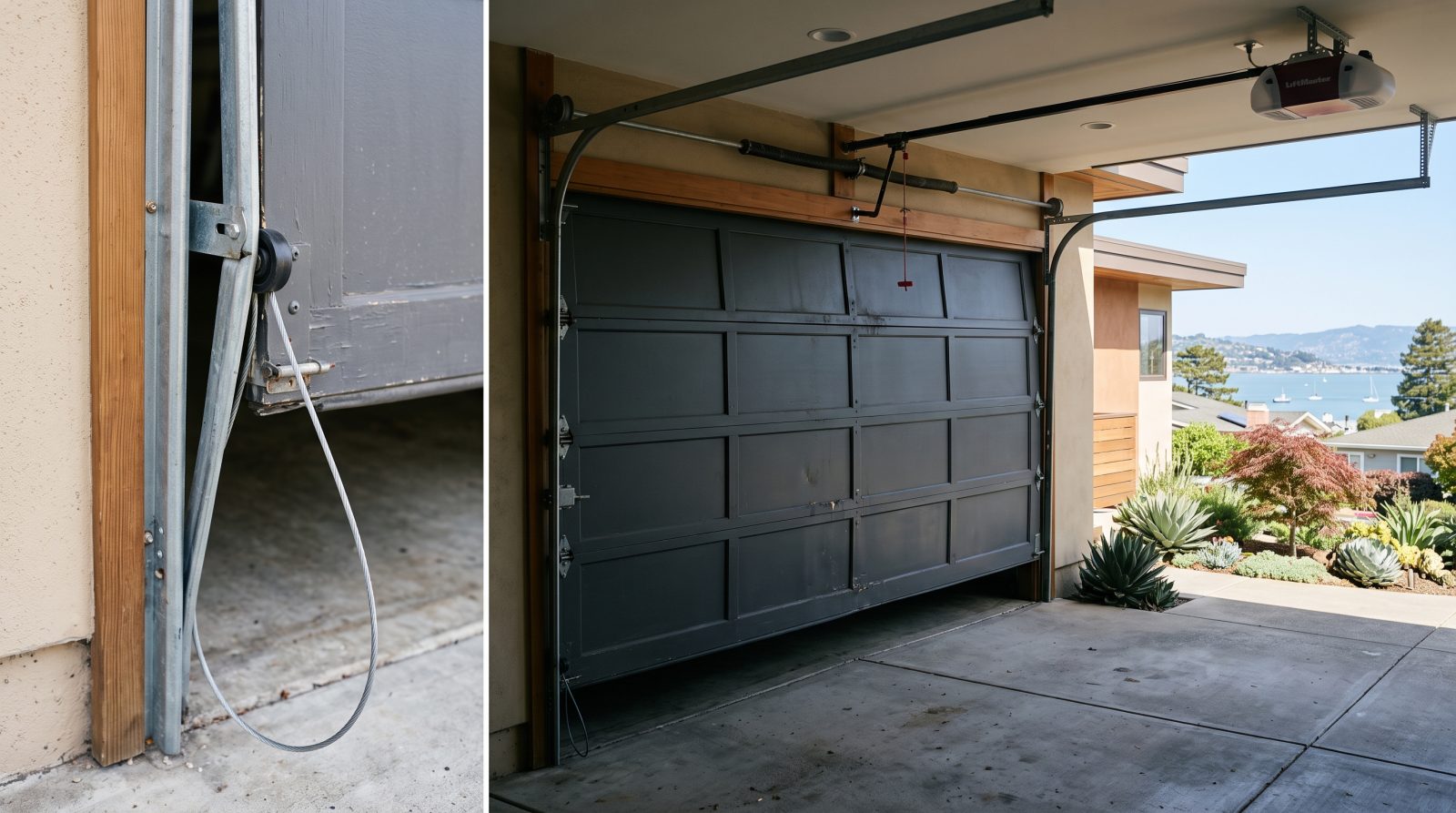
- One side lifts, the door goes crooked or jams: likely a broken cable or a roller off its track; stop using the door to avoid further damage.
The Broken Spring and Cable Problem (Why You Should Stop Here)
The most common reason a heavy garage door truly won't open, and the most important one to get right, is a broken torsion or extension spring. Springs do the real lifting work; the opener mostly just guides a door that the springs have already counterbalanced. When a spring snaps, the door can suddenly weigh well over a hundred pounds at the bottom, far more than the opener is built to lift, which is why the motor hums or strains and gives up.
Springs and the cables that run alongside them are under extreme tension, and they are the part of the system responsible for the most serious DIY injuries. A snapped spring or a slipped cable can release that stored energy violently. This is the clear line in garage door repair: diagnosis is fine for a homeowner, but the actual repair or replacement of springs and cables should be left to a trained technician with the right tools. There is no shortcut here that's worth the risk.
Spring lifespan is often rated in cycles (one open plus one close equals one cycle), and it varies with use and climate. Homes in colder regions can see springs fatigue faster because cold steel is more brittle and doors get used more in winter, while coastal and humid areas see more cable corrosion. None of this changes the rule: if a spring or cable has failed, get a local pro to handle it.
- Tell-tale signs of a broken spring: a loud bang earlier in the day, a visible gap in the coiled spring above the door, or a door that's far too heavy to lift by hand.
- Springs are commonly replaced in matched pairs even if only one breaks, because the second is usually near the end of its life too; ask any technician to explain their recommendation.
- Frayed, loose, or hanging cables mean the door can come down unevenly or unexpectedly; stop using it and keep people and vehicles clear.
- Resist DIY spring kits unless you have the proper winding bars, training, and a clear understanding of the tension involved; the savings are not worth the injury risk.
What You Can Safely Fix Yourself Right Now
Plenty of "won't open" situations come down to small, low-risk fixes that any homeowner can handle. If your earlier checks pointed to power, sensors, or the remote rather than the springs or door balance, these steps will often get you back in business without a service call.
Remote and keypad issues are the easiest wins. Replace the remote battery, re-program the remote to the opener following the manufacturer's instructions, and check the keypad battery if you use one. For sensor problems, gently realign the photo-eyes so they point directly at each other and wipe the lenses clean; direct sunlight or a stray cobweb is sometimes all it takes to confuse them.
If you've pulled the emergency release in the past, the trolley may simply need to be re-engaged. With the door fully closed, re-attach the release per your opener's manual, then run the opener through a full cycle. Light lubrication of rollers, hinges, and the track with a garage-door-rated lubricant (not a heavy grease that attracts grit) can also free up a door that's sticking from friction or cold.
- Replace remote and keypad batteries before assuming the opener has failed; it's the most common false alarm.
- Realign and clean the photo-eye sensors; both indicator lights should be steady, not blinking.
- Reset a tripped breaker or GFCI outlet, then test the opener again.
- Re-engage the manual release trolley if it was pulled, with the door closed, following your opener's manual.
- Lubricate rollers, hinges, and tracks with a product made for garage doors to reduce sticking, especially in cold weather.
- Know when to stop: if a fix involves spring tension, cable winding, or lifting a heavy unbalanced door, that's the point to call a local pro.
Typical Repair Costs and When to Call a Local Pro
Once you've narrowed down the cause, it helps to have a realistic sense of what a repair tends to cost so you can recognize a fair quote. The figures below are typical industry ranges offered as estimates only; the real price depends on your specific door, the parts and materials involved, your region, and the scope of work. They are not a quote or a guarantee, and a reputable technician will always confirm pricing with you before starting.
As a general guide, remote or sensor fixes are often inexpensive and sometimes free if it's just a battery or alignment. Spring replacement commonly runs in the low-to-mid hundreds of dollars depending on door size and spring type, cable replacement is usually a moderate cost, and a new opener installation typically lands in the mid-hundreds, more for higher-end smart units. Prices generally run higher in high-cost metro areas and lower in smaller markets, and a full diagnostic visit may carry a service fee that's sometimes applied toward the repair.
The simplest rule of thumb: if your checks point to power, batteries, sensors, or a re-engaged release, try the DIY route first. If they point to springs, cables, an unbalanced or off-track door, or a dead motor, that's the moment to bring in a trained technician. The convenience of this site is getting that local help to your door quickly, wherever you are, so a stuck door doesn't turn into a lost day. When you're ready, you can request a free quote and get a clear diagnosis before any work begins.
- Remote/sensor/battery fixes: typically low cost or free; often a true DIY win.
- Spring replacement: commonly low-to-mid hundreds, varying by door size, spring type, and region; estimate only.
- Cable replacement: usually a moderate cost; springs and cables are often serviced together.
- New opener installation: typically mid-hundreds and up, more for smart or heavy-duty units.
- Watch for a service or diagnostic fee, which some pros credit toward the final repair; always confirm pricing up front.
- Get multiple data points if a quote feels high, and make sure the technician explains what's being replaced and why.