What Makes a Carriage House Door Different
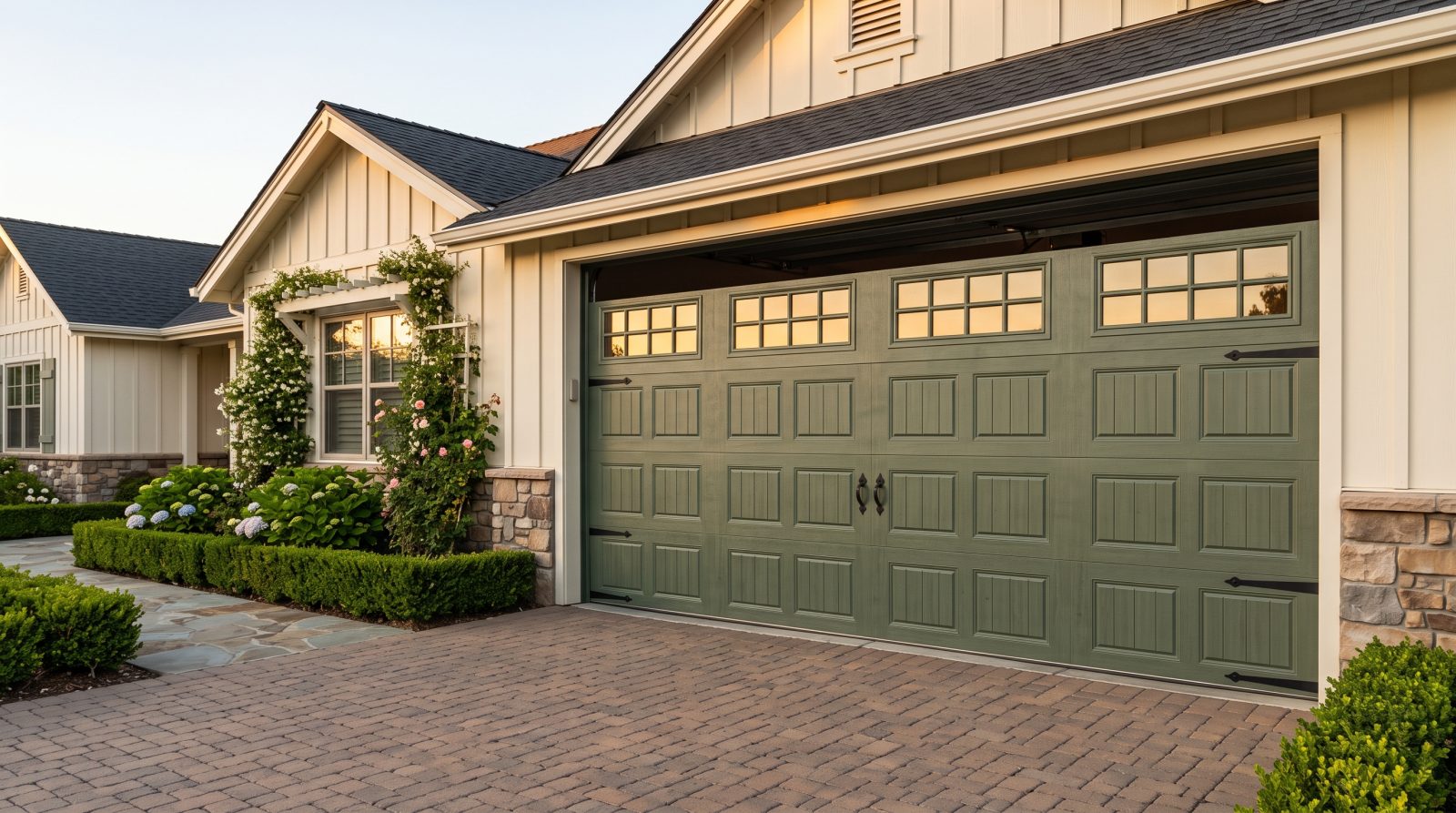
Carriage house doors are defined by their look, not by a single mechanism. The style recreates the appearance of the side-hinged, swing-open doors that once closed off carriage houses and barns, with details like vertical or X-pattern bracing, decorative strap hinges, handles, and small rows of windows near the top. The key thing most homeowners miss is that the vast majority of carriage house doors sold today are not true swing doors at all: they are standard sectional overhead doors or roll-up doors dressed in carriage-style trim. They lift straight up on a track and run on the same springs, cables, and rollers as any other modern door.
That distinction matters enormously for repair. A 'carriage house door' that rolls up overhead breaks and gets fixed exactly like any other sectional door, which means parts are widely available and most pros can service it. A genuine swing-out or slide-to-the-side carriage door uses hinges, pivots, and sometimes a jackshaft-style operator instead of a typical opener, so it needs a tech who understands that hardware. Knowing which type you have is the first step in any repair conversation, and it is something a technician can confirm in seconds at the door.
The trade-off you are buying with a carriage house design is appearance over absolute simplicity. The decorative hardware, the heavier or layered construction, and the optional glass all add visual richness, and sometimes a little extra weight and a few more failure points than a plain flush panel door. None of that is a reason to avoid the style. It just means the door benefits from correct spring sizing and regular tune-ups so the look keeps working as well as it shows.
- Overhead sectional carriage doors: lift straight up, run on standard springs/tracks, easiest to service nationwide
- True swing-out or slide carriage doors: use hinges/pivots, need a pro familiar with that specific hardware
- Signature details: recessed or raised panels, strap hinges, handles, optional divided-light window sections
- The 'carriage' part is the styling; the lifting mechanism is usually the same as any modern door
Materials and How They Hold Up by Region
Carriage house doors come in steel, wood, wood-composite, and increasingly faux-wood or fiberglass facings, and the right choice depends heavily on where you live. Real wood, often cedar, hemlock, or a hardwood overlay, gives the most authentic carriage look and the deepest grain, but it asks for the most upkeep. In hot, sunny, or coastal regions wood expands, contracts, and weathers faster, so a homeowner in a humid Gulf or Pacific Northwest climate will refinish more often than someone in a mild, dry area. Wood also tends to be the heaviest option, which puts more demand on the springs and opener over time.
Steel carriage doors, usually a steel skin over a polyurethane or polystyrene insulated core with a carriage-style overlay, are the most common nationwide for good reason. They resist warping, handle temperature swings well, and an insulated steel door helps in both cold-winter and hot-summer climates by moderating garage temperature and adding rigidity. In snowy and freeze-thaw regions, insulation and good bottom-seal weatherstripping make a real difference. Composite and faux-wood doors split the difference: they mimic wood grain convincingly while shrugging off rot and most moisture, which makes them a strong pick in damp or high-UV areas where genuine wood struggles.
Insulation is worth a specific mention because carriage house buyers often focus on looks and forget R-value. If your garage is attached, shares a wall with living space, or doubles as a workshop or gym, an insulated carriage door pays off in comfort and quieter operation almost everywhere in the country. In very cold climates it can reduce strain on the door system in freezing conditions; in very hot climates it keeps the garage from becoming a furnace. The visible carriage styling is identical whether the core is insulated or not, so there is rarely a reason to skip it.
- Wood/wood overlay: most authentic look, most maintenance; struggles more in humid, coastal, or high-UV regions
- Insulated steel: most popular and durable; best all-climate value and helps with temperature and noise
- Composite/faux-wood: wood look without the rot risk; strong in damp or sunny climates
- Insulation matters most for attached garages, freezing winters, and scorching summers
Common Carriage House Door Problems and Fast Diagnosis
Because most carriage house doors are sectional overhead doors underneath the styling, they fail in the same familiar ways, and the symptoms are usually easy to read. A loud bang from the garage followed by a door that won't lift is almost always a broken torsion or extension spring. The springs, not the opener, do the heavy lifting, so when one snaps the opener can't raise the door and you should not force it. A door that comes off its track, looks crooked, or jams partway is an off-track or roller issue, often from a worn roller, a bent track, or a frayed cable. A door that reverses right after touching the floor, or won't close at all, frequently points to misaligned safety sensors, a binding section, or a force-setting problem on the opener.
Carriage-specific quirks are worth knowing too. The decorative hardware, strap hinges and handles, is usually cosmetic on overhead models, so a loose or rattling handle is rarely the real fault. The window sections add weight to the top panel and can develop seal or insert issues over time. On heavier wood carriage doors, springs and openers simply work harder, so worn rollers, stretched cables, and tired springs can show up sooner than on a lightweight door. The good news is that none of this is exotic to a trained tech, and most of these problems are routine same-day repairs.
A simple at-home triage helps you describe the problem and avoid unsafe DIY. Look and listen first: is the door fully off the track, or just balky? Is there a visible gap in a spring coil above the door? Do both photo-eye sensors near the floor glow steadily, or is one blinking or knocked out of alignment? Has anything obviously bent, snapped, or come loose? Springs and cables are under extreme tension and are the leading cause of serious garage door injuries, so a broken spring, snapped cable, or door hanging off its track is a stop-and-call-a-pro situation, not a weekend fix.
- Loud bang, then door won't lift: almost always a broken spring; do not force it open
- Crooked, jammed, or derailed door: off-track, worn roller, bent track, or frayed cable
- Door reverses or won't close: check the two floor-level safety sensors for alignment first
- Loose decorative handles/hinges on overhead doors are usually cosmetic, not the underlying fault
- Broken springs, snapped cables, and off-track doors are unsafe to DIY; call a local pro
What Carriage House Doors Typically Cost
Pricing for carriage house doors varies widely by material, size, insulation, glass, and hardware, so the figures here are typical industry ranges and estimates, not a quote. As a general guide, basic steel carriage-style doors tend to sit at the lower end, insulated steel and composite in the middle, and custom or solid wood carriage doors at the top, sometimes well into premium territory for large, multi-car, or fully custom designs. Add-ons like decorative window sections, upgraded hardware, smart openers, and custom finishes push the number up. A double-wide door naturally costs more than a single, and professional installation is typically a separate line from the door itself.
Repairs are a different and usually much smaller expense than replacement. Common fixes such as spring replacement, roller or cable replacement, sensor realignment, or opener service generally fall into modest service ranges, with springs and opener work toward the higher end of typical repair costs and small adjustments toward the lower end. Because labor, parts availability, and local rates differ across regions, the same repair can vary noticeably from one part of the country to another. Heavier wood carriage doors can also run slightly higher on parts because they may need stronger springs or more robust components.
The most useful way to think about cost is repair-first. A door that 'died' overnight is very often one broken spring or one bad cable away from working perfectly again, at a fraction of replacement cost. It is worth getting a real diagnosis before assuming you need a whole new door, especially with carriage house doors where a full custom replacement can be a significant investment. A local technician can tell you on-site whether a quick repair restores the door or whether age and wear make replacement the smarter long-term call, and you can request a free quote either way.
- Door prices (estimates): basic steel lowest, insulated steel/composite mid, custom wood highest
- Cost drivers: size, insulation, window sections, hardware, finish, and single vs. double width
- Repairs usually cost far less than replacement; spring/cable/sensor fixes are common and routine
- Rates vary by region; treat all figures as typical ranges, never a guaranteed price
- Get a diagnosis before replacing: many 'dead' doors need one part, not a new door
Keeping the Look (and the Door) Working
Carriage house doors reward a little routine maintenance with a long, good-looking, trouble-free life. A few times a year, visually inspect the springs, cables, rollers, and tracks for wear, rust, or fraying, and listen for new grinding, popping, or scraping during operation, which often signals a part starting to fail. Keep the tracks clear of debris and lubricate the rollers, hinges, and springs with a proper garage door lubricant rather than a generic spray. Test the door's balance by disconnecting the opener and lifting the door halfway by hand; a well-balanced door stays roughly in place, while one that slams down or shoots up signals a spring problem that a pro should adjust.
The styling itself needs care too, and this is where carriage doors differ from plain panels. Wood and wood-overlay doors should be inspected for finish wear, cracking, or moisture intrusion, and refinished or resealed on a schedule appropriate to your climate, more often in harsh sun or high humidity. Steel and composite carriage doors mainly need a gentle wash to keep the overlay and hardware looking sharp. Check that decorative hardware is secure, that window seals and inserts are intact, and that weatherstripping along the bottom and sides is still sealing, which protects both the garage and the door's longevity in wind, rain, and snow.
Maintenance is also your early-warning system. Most catastrophic, lock-you-out failures give quiet hints first: a slightly louder operation, a door that hesitates, a cable that looks a little frayed, a spring with a small gap forming. Catching those early turns a potential emergency into a planned, inexpensive service visit. If anything looks worn, sounds wrong, or feels heavy and unbalanced, it is far safer and usually cheaper to have a local technician check it than to wait for it to break, and a good pro will tell you honestly whether it needs attention now or can wait.
- Inspect springs, cables, rollers, and tracks a few times a year for wear, rust, or fraying
- Lubricate moving parts with garage door lubricant; keep tracks clean and clear
- Refinish/reseal wood doors on a climate-appropriate schedule; wash steel/composite to keep them sharp
- Test balance with the opener disconnected; an unbalanced door means a spring needs professional adjustment
- Small new noises and minor fraying are early warnings, address them before they become a lockout