How to Tell If Your Garage Door Spring Is Broken
Spring failure usually announces itself. Many homeowners report hearing a loud bang, like a firecracker or a snapping cable, somewhere in the garage, often when no one is touching the door. That sound is the spring fracturing and releasing its stored tension all at once. After that, the door simply refuses to behave normally.
The most reliable way to confirm a broken spring is to look and to test, carefully. A garage door system is balanced so that the springs do almost all of the lifting; the opener just guides the door along. When a spring breaks, that balance is gone, and the symptoms become obvious fast. Before you call, a quick visual check of the springs above or alongside the door can tell you a lot, but do not pull cables, touch the spring, or try to force the door.
- A visible gap in the spring: a torsion spring (mounted on a bar above the door) will show a two-to-three-inch separation where it snapped.
- The door won't open with the opener, or it opens only a few inches, then stops, because the motor isn't built to lift the full dead weight of the door.
- The door feels extremely heavy when you try to lift it by hand after disconnecting the opener; a balanced door should rise with modest effort.
- The door drops fast or slams shut instead of staying put when partially raised.
- Crooked or jerky movement, or one side hanging lower than the other, which can point to one of two extension springs failing.
- Loose, slack, or dangling cables, which often accompany a spring failure.
Torsion vs. Extension Springs: Know What You Have
Residential garage doors use one of two spring systems, and the difference matters for diagnosis, safety, and cost. Knowing which type you have helps you describe the problem accurately when you request service, and it sets your expectations for the repair.
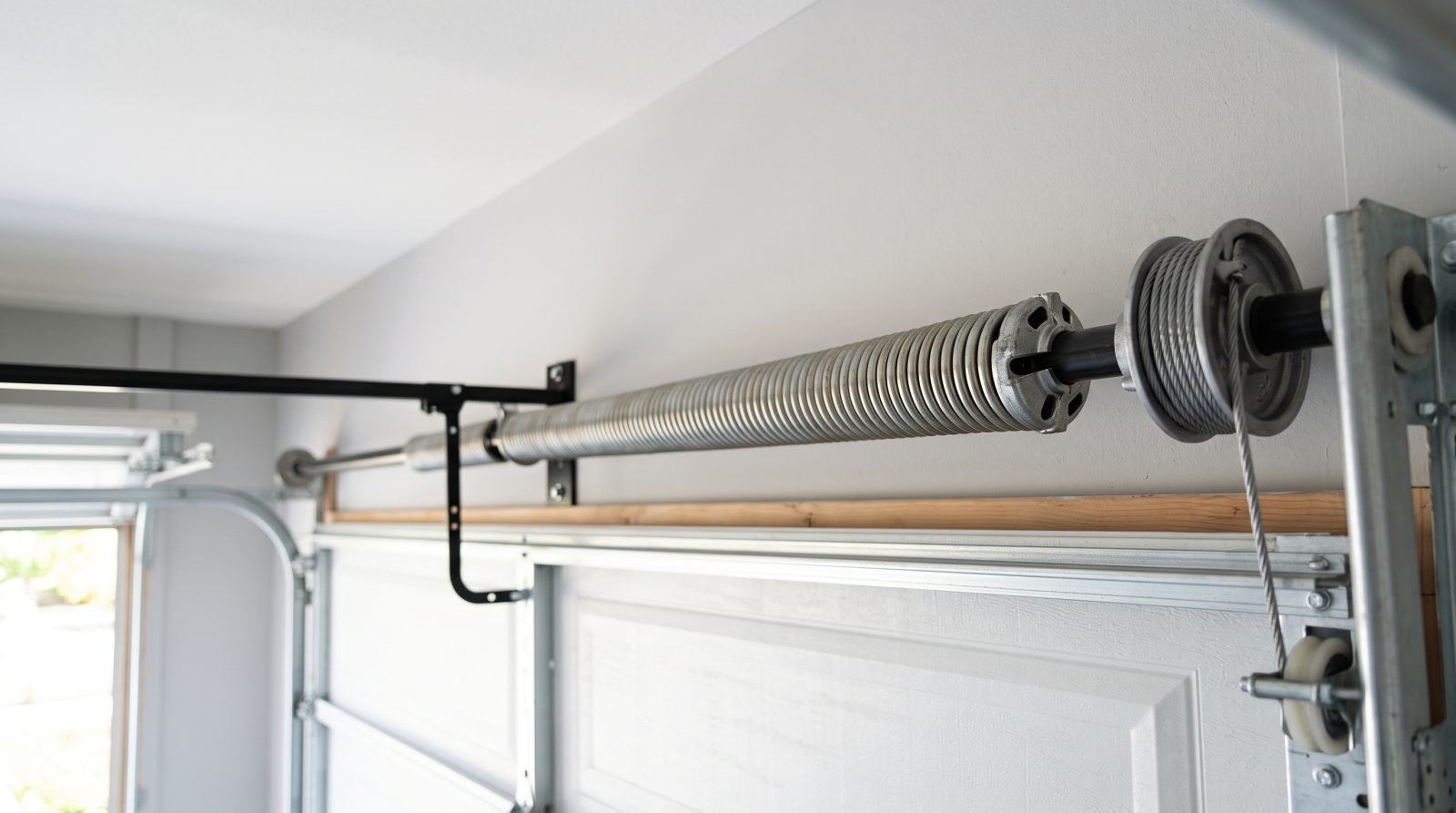
Torsion springs are the metal coils mounted horizontally on a steel shaft directly above the closed door. They work by twisting (torquing) to store energy, and they raise the door in a smooth, controlled motion. They're common on heavier and newer doors, generally last longer, and are considered the more durable, safer-operating system, but they are also under tremendous tension and are the more dangerous to service.
Extension springs are the long, lighter-gauge springs that run parallel to the horizontal tracks on either side of the door, stretching and contracting as the door moves. They're often found on older or lighter single-car doors. Because they expand and snap back forcefully when they fail, a properly installed extension-spring system should always include a safety cable running through each spring to contain it if it breaks. If your extension springs lack safety cables, that's an important upgrade to ask a technician about.
- Torsion: mounted on a shaft above the door, twists to lift, smoother and longer-lasting, typically used on heavier doors.
- Extension: mounted along the side tracks, stretches to lift, more common on older or lighter doors, must have a containment safety cable.
- Many double (two-car) doors use one or two torsion springs; a setup with two torsion springs lets the door keep limping along if one breaks, though it still needs prompt repair.
- Matching spring type, size, wire gauge, and wind direction to your specific door is critical, which is why measurements and a trained eye matter.
Why Garage Door Springs Break
Springs don't fail randomly; they wear out, and understanding why helps you anticipate the next failure and protect both springs at once. Nearly every spring failure traces back to one of a few causes, and most are simply a matter of physics and time rather than a defect.
The biggest factor is cycle life. A spring is rated for a number of cycles, where one cycle is the door going up and back down. Standard springs are often rated in the range of roughly 10,000 cycles, while higher-grade springs can be rated far higher. A household that runs the door a few times a day will reach the end of a standard spring's life in several years; a busy family using the garage as the main entrance can wear one out much faster.
Climate and corrosion play a real and region-dependent role. In coastal and humid areas, salt air and moisture accelerate rust, and rust increases friction inside the coils and creates weak points where the metal eventually cracks. In cold-winter regions, steel becomes more brittle, and the strain of lifting a door in freezing temperatures is a classic moment for a tired spring to finally snap, which is why so many spring failures happen on the first hard cold morning. Dry, temperate climates are gentler on springs, but no spring lasts forever.
- Normal wear: every open-and-close uses up a small slice of the spring's rated cycle life until metal fatigue causes a break.
- Rust and corrosion: especially in coastal, humid, or high-moisture climates, where rust weakens the coils and adds friction.
- Cold and temperature swings: brittle steel in freezing weather makes winter a peak season for spring breaks.
- Poor maintenance: dry, un-lubricated springs and an unbalanced door wear faster.
- Wrong-sized or low-grade springs from a previous install: undersized springs are overworked from day one and fail early.
- Age: many springs simply reach the end of their service life, often after a number of years, regardless of how careful you've been.
Why Spring Repair Is a Job for a Professional
Garage door springs are one of the few home-repair items where the standard, responsible advice is unambiguous: do not attempt this yourself. A torsion spring stores hundreds of pounds of force in a tightly wound coil, and the winding bars, tension, and clearances involved leave very little margin for error. Slipping a winding bar or releasing tension the wrong way can cause severe hand, face, and eye injuries, and broken springs and snapped cables are a well-documented source of garage injuries every year.
Beyond safety, there's the matter of getting it right. A correct repair means selecting the proper spring type and wire gauge for your door's exact weight and height, winding it to precisely the right tension, and re-balancing the door so the opener isn't forced to overwork and burn out. The wrong spring or wrong tension leaves the door unbalanced, which quietly destroys the opener, the rollers, and the new spring itself.
A professional visit is also a chance to catch the problems that travel with a broken spring. A technician can inspect the cables, drums, bearings, rollers, and the opener's force settings, and confirm the door's safety features are working. That whole-system check is hard to replicate with a quick DIY swap, and it's the difference between a fix that lasts and one that fails again in months.
- Extreme stored tension makes torsion springs genuinely dangerous to wind or unwind without the right tools and training.
- Specialized winding bars and the correct technique are required; household tools are unsafe substitutes.
- Correct spring sizing and tension protect the opener and the rest of the hardware from premature wear.
- A pro inspects cables, drums, bearings, and rollers that often need attention at the same time.
- Many professional repairs include workmanship and parts coverage, which a DIY attempt cannot offer; ask your technician what their work includes.
Repair or Replace? What to Expect and Typical Costs
With springs, the smart move is usually to replace, not patch. A broken spring can't be meaningfully repaired; it's replaced. The more important decision is whether to replace just the broken spring or both at once. If your door uses two springs of the same age and one has failed, the second is almost certainly close behind. Replacing them as a pair saves you a second service call, a second trip charge, and another stretch of an out-of-service door, and it keeps the system balanced. Most technicians will recommend replacing in pairs for exactly these reasons.
It's also worth asking about an upgrade to a higher-cycle spring. If your door is a high-traffic main entrance, a longer-life spring rated for far more cycles can be a worthwhile investment that meaningfully delays the next replacement. A technician who knows your door's weight and usage can tell you whether it makes sense for you.
On cost, treat any number you see online, including ours, as a typical industry range and an estimate, never a quote. Actual price depends on your spring type, size and wire gauge, door weight, whether you replace one spring or two, your region, and whether related parts like cables or bearings also need work. As a rough, ballpark guide that varies widely by market, single-spring replacements commonly fall somewhere in the low-to-mid hundreds of dollars, with two-spring or torsion conversions and premium high-cycle springs running higher. The only reliable figure is a real, on-site assessment of your door.
- Springs are replaced, not repaired, once broken.
- Replacing both springs together is usually recommended when they're the same age, to save on repeat visits and keep the door balanced.
- High-cycle spring upgrades can extend service life significantly for heavy-use doors.
- Costs are estimates that vary by spring type, door weight, region, and any related parts; they are not fixed quotes or guarantees.
- An on-site inspection is the only way to get an accurate price for your specific door.
Getting Fast, Local Spring Repair Wherever You Are
A broken spring usually means a door that's stuck open and exposing your home, or stuck shut and trapping your car, so speed matters. The good news is that spring replacement is a routine, well-understood repair, and a properly equipped local technician can often handle it in a single same-day visit once they've confirmed the door's specifications.
Garage Door Repairs Near Me connects you with garage door repair help close to you, wherever you happen to live, with the convenience of a fast local response rather than a long wait. When you reach out, it helps to have a few details ready: roughly how old the door is, whether it's a single or double door, and which spring type you have if you can tell. A quick photo of the spring assembly can speed up diagnosis and help the technician arrive with the right parts.
If your door is down and you're stuck, leave it down and avoid forcing it; if it's stuck open, keep people and pets clear and don't try to wrestle it shut. Then get a qualified pro on the way. Ready to get moving? Request a free quote and we'll help you get a local technician to your door fast.
- Spring replacement is routine and is often completed same-day once the door's specs are confirmed.
- Have your door's age, size (single vs. double), and spring type handy to speed up the visit.
- A photo of the spring assembly helps the technician bring the correct parts the first time.
- Don't force a door with a broken spring; keep the area clear and let a pro handle the tension safely.