What Drives the Cost of a Garage Door Repair
Two homes can call about the "same" problem and get very different estimates, and usually there is a good reason. Garage door repair pricing is built from a handful of variables that stack on top of each other. Understanding them is the difference between feeling gouged and feeling informed, and it helps you compare quotes apples-to-apples instead of chasing the lowest number on the phone.
The biggest driver is the specific part that failed and its quality tier. A builder-grade torsion spring is not the same as a high-cycle spring rated for two to three times the lifespan, and the price reflects that. Door size and weight matter too: a heavy two-car or insulated steel door needs stronger, costlier components than a light single-car door. Then there is labor, which swings with regional wage rates and how accessible your hardware is. A low-headroom garage, a door wedged off its tracks, or rusted, seized bolts all add time, and time is most of the labor bill.
Climate and region quietly shape cost as well. In humid coastal and Gulf areas, corrosion shortens the life of springs, cables, and fasteners, so repairs come up more often and galvanized or coated parts are worth the small premium. In cold-winter regions, grease stiffens, metal contracts, and springs are under more stress on frigid mornings, which is why so many breaks happen in the first cold snap. None of this means you should accept a vague number, it just explains why a good tech diagnoses in person before committing to a price.
- Part type and quality tier (standard vs. high-cycle or coated/galvanized components)
- Door size, weight, and material (single vs. double, wood vs. steel vs. insulated)
- Labor rates in your region plus how accessible and corroded the hardware is
- Whether it is a single fix or several worn parts failing together
- Service timing, since same-day and after-hours visits can carry a premium
Torsion and Extension Spring Replacement
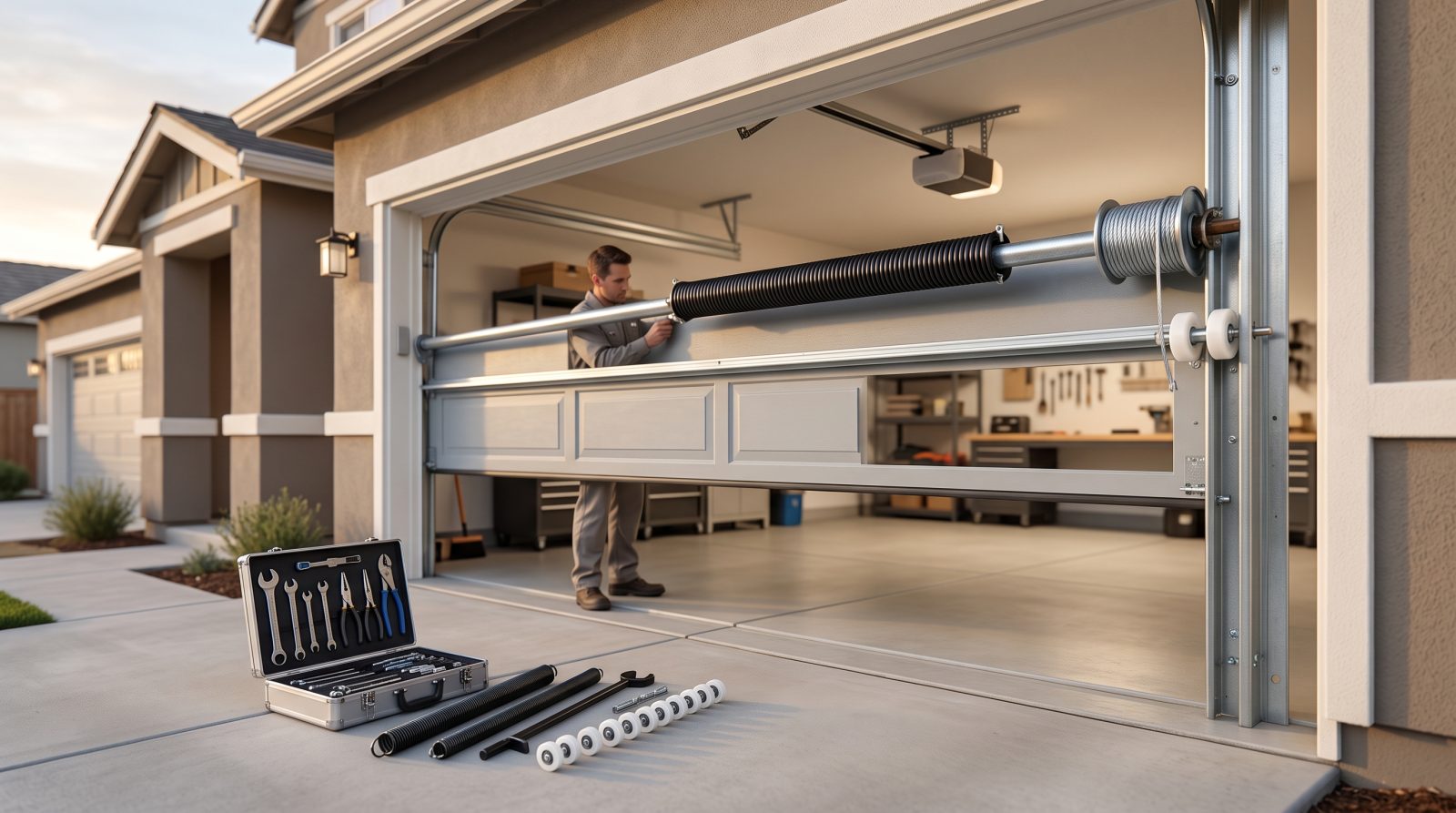
Springs are the number one garage door repair, and for good reason: they do the heavy lifting every single time the door moves, and they are wear items with a finite cycle life. A typical spring is rated for roughly 10,000 cycles, which for an average household lands somewhere around seven to twelve years, less if you run the door constantly or live where temperature swings are extreme. When a spring snaps, the door becomes dangerously heavy and often will not open at all, so this is one of the most common reasons people search for fast help nearby.
As a national estimate, spring replacement commonly falls in the range of roughly 150 to 350 dollars for a single spring including parts and labor, with many double-door jobs landing higher because they often use two springs. Torsion springs (mounted on a bar above the door) generally cost more than older-style extension springs (running alongside the tracks) but tend to last longer and operate more smoothly. Upgrading to high-cycle springs raises the upfront cost but can roughly double the lifespan, which is often worth it for busy households.
A few cost notes worth knowing. If you have two springs and one breaks, most reputable techs recommend replacing both, since the second is usually near the end of its life and a second callout costs you another trip fee. Spring work is also genuinely hazardous, those springs store enormous tension, so this is not a DIY-friendly repair. The labor premium for a trained tech is buying you safety, not just convenience.
- Single spring replacement: roughly 150 to 350 dollars (parts and labor), a national estimate
- Double-door jobs often run higher because they commonly use two springs
- High-cycle spring upgrades cost more upfront but can roughly double lifespan
- Replacing both springs together is common practice and saves a second trip fee
Garage Door Opener Repair and Replacement
The opener is the motor unit that does the automated lifting, and "opener problems" cover a wide range of fixes at very different price points. Sometimes the issue is cheap and quick, a dead remote battery, a misaligned safety sensor, or a worn gear, and sometimes the motor itself has reached end of life. Because the symptoms overlap (the door will not respond, reverses unexpectedly, or runs but does not move), an in-person diagnosis is what separates a 100-dollar fix from a full unit swap.
For minor opener repairs, think realigning the photo-eye sensors, replacing a remote or keypad, or swapping a stripped drive gear, typical costs often land in the rough range of 100 to 250 dollars. A full opener replacement, including the new unit and installation, more commonly falls somewhere around 300 to 600 dollars or more, depending on the drive type and features. Chain-drive units are usually the most affordable; belt-drive units cost more but run noticeably quieter, which matters if there is a bedroom above or beside the garage. Smart openers with Wi-Fi, battery backup, and app control sit at the higher end.
One regional note: in areas with frequent power outages or storms, a model with battery backup is increasingly standard and worth the premium, so you are not stranded with a door you cannot open. If your opener is more than roughly fifteen years old and needs a significant repair, it is often smarter to put that money toward a new unit than to keep patching an aging motor.
- Minor opener repairs (sensors, remotes, gears): roughly 100 to 250 dollars, a national estimate
- Full opener replacement with installation: commonly around 300 to 600 dollars or more
- Chain-drive is most economical; belt-drive costs more but is much quieter
- Smart and battery-backup models sit at the higher end and are worth it in outage-prone areas
Cables, Rollers, Tracks, and Off-Track Doors
Beyond springs and openers, a cluster of smaller hardware components keeps the door moving smoothly and safely, and these are some of the most common service calls. Lift cables work in tandem with the springs and can fray or snap; rollers guide the door along the track and wear out or seize; hinges crack; and tracks can bend or come loose. Many of these parts are inexpensive on their own, so the cost is largely about labor and how many items are worn at once.
As rough national estimates, cable replacement often runs in the range of 100 to 200 dollars, roller replacement (typically done as a full set) commonly lands around 100 to 200 dollars depending on roller quality, and minor track realignment or bracket tightening can be on the lower end if it is a quick fix. Upgrading from plain steel rollers to nylon rollers costs a bit more and runs much quieter and smoother, a popular small upgrade. A door that has come off its tracks is a more involved repair: it usually means realigning or replacing track sections, resetting rollers, and inspecting the cables and springs that may have caused or resulted from the derailment, so it tends to cost more than a single-part swap.
A safety word on off-track doors: do not force a derailed door open or closed, and do not keep hitting the opener. A door off its tracks is unstable and can fall. This is exactly the kind of problem where getting a local pro to the door quickly prevents a moderate repair from becoming an expensive one, or an injury.
- Cable replacement: roughly 100 to 200 dollars, a national estimate
- Roller replacement (full set): commonly around 100 to 200 dollars depending on quality
- Nylon roller upgrades cost slightly more but are quieter and smoother
- Off-track door repairs cost more because they involve tracks, rollers, cables, and springs together
Service Calls, Diagnostics, and Reading an Estimate
Almost every repair starts with a service or diagnostic fee, the cost of getting a qualified tech to your home to assess the problem. This commonly runs in the rough range of 50 to 100 dollars, and many companies credit it toward the repair if you proceed. Knowing this upfront helps you avoid surprise and lets you ask the right question before booking: "Is the service fee applied to the work if I move forward?"
A trustworthy estimate is itemized. It should separate parts from labor, name the specific components being replaced and their quality tier, and note any warranty on parts and workmanship. Be cautious of a quote that is dramatically lower than others, it sometimes signals builder-grade parts that will fail sooner, or a number that climbs once the tech is on site. Equally, the highest quote is not automatically the best; what you want is a clear, written breakdown you can understand. Asking whether both springs or a full roller set are being replaced (versus just the broken one) tells you a lot about whether you are looking at a quick patch or a lasting fix.
Finally, weigh repair against replacement honestly. If your door is older and multiple systems are failing in the same season, springs, then cables, then the opener, the running total can approach the cost of a new door, and a new door comes with fresh warranties and better efficiency. A good pro will tell you when repair is the smart call and when it is throwing money at an aging system, and you should expect that candor wherever you are. When you are ready, request a free quote and have the most common failure points checked in one visit so you are not paying for repeat trips.
- Service/diagnostic fee: roughly 50 to 100 dollars, often credited toward the repair
- A good estimate itemizes parts, labor, component quality, and warranty in writing
- Suspiciously low quotes can mean cheaper parts or a price that rises on site
- When several systems fail in one season on an older door, compare repair cost to a full replacement